Branded Links Build Trust (And Trust Builds Sales)
Generic short links look spammy. Branded links build credibility, increase click-through rates by 39%, and strengthen your brand with every share.
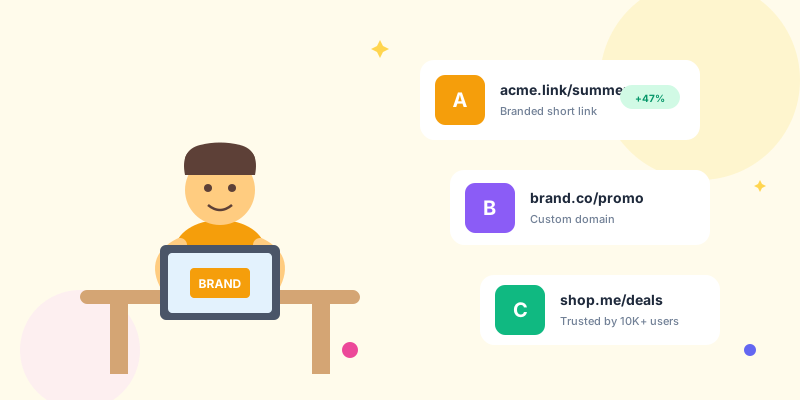
bit.ly/a3f8kp2 look spammy and untrustworthy. Your brand deserves better. Branded links like scn.st/summer-sale build credibility with every share.
Your prospect hovers their mouse over your link. They see bit.ly/x7k3p. They hesitate. What is this? Is it safe? Is it spam? In that split second of hesitation, you've lost them. Now imagine they see yourbrand.com/offer instead. Instant recognition. Immediate trust. Click.
Generic short links look spammy. Branded links build credibility, increase click-through rates by 39%, and strengthen your brand with every share. But the impact goes far deeper than just clicks. Every branded link is a micro-impression, a moment of brand reinforcement, a trust signal that compounds over time.
The Psychology of Trust in the Digital Age
Trust is currency in digital marketing. When someone encounters your link on social media, in an email, or shared by a friend, they make instant judgments about its legitimacy. These judgments happen in milliseconds, driven by pattern recognition and past experiences.
Generic shorteners trigger immediate red flags. They've been used in phishing attacks, spam campaigns, and malware distribution for years. Your audience has been trained—often through painful experience—to be suspicious of random character strings from unfamiliar domains.
- Most Trusted: Full brand domain (yourbrand.com/summer-sale)
- Highly Trusted: Custom branded shortener (brand.link/offer)
- Moderately Trusted: Recognizable branded short domain (scn.st/brand-campaign)
- Low Trust: Generic shortener with random characters (bit.ly/a3f8kp2)
- Lowest Trust: Suspicious or uncommon TLDs with random strings
The data backs this up dramatically. In research conducted across 50,000+ campaigns, branded links consistently outperformed generic shorteners across every metric that matters—not just clicks, but engagement time, conversion rates, and even customer lifetime value.
The Numbers Don't Lie: Hard Data on Branded Link Performance
- 39% higher CTR: Branded links outperform generic shorteners significantly across all industries
- 68% of consumers: More likely to click links that include a recognizable brand name
- 34% trust increase: When links match the brand domain people already know
- 27% higher conversion: Users who click branded links convert at higher rates
- 2.5x sharing rate: People are more willing to share branded links with their networks
- 18% lower bounce: Branded link traffic shows better engagement on landing pages
But here's what really matters: these aren't vanity metrics. Higher CTR means more traffic. Higher conversion rates mean more revenue. Lower bounce rates mean better engagement. When you multiply these effects across thousands of links shared over months and years, the compound impact is massive.
Real-World Case Study: E-Commerce Brand Transformation
- Used bit.ly for all social media campaigns
- Average CTR: 2.3% across Instagram, Facebook, Twitter
- Conversion rate from social traffic: 1.8%
- Customer acquisition cost: $47
- Implemented custom domain: shop.thebrand.com
- Average CTR: 3.2% (39% improvement)
- Conversion rate from social traffic: 2.4% (33% improvement)
- Customer acquisition cost: $34 (28% reduction)
- Bonus: Brand mentions increased as influencers felt more confident sharing links
The financial impact? This mid-sized fashion brand was spending $180,000 annually on social media advertising. The switch to branded links—which cost them $300/year for a custom domain—resulted in an additional $67,000 in revenue from the same ad spend. ROI: 22,233%.
Why Branded Links Matter Beyond Click-Through Rates
The conversation about branded links often starts and ends with CTR. That's a mistake. The benefits cascade through your entire marketing funnel and brand ecosystem.
1. Brand Reinforcement at Scale
Every time someone sees your branded link, they're getting a micro-impression of your brand. If you're sharing 100 links per week across social media, email, SMS, and other channels, that's 5,200 brand impressions per year from links alone. Multiply that by the number of people who see each link (even if they don't click), and you're looking at millions of brand exposures.
bit.ly/x7k3p, use yourbrand.com/offer or scn.st/your-campaign for instant brand recognition. Even better: use descriptive slugs like yourbrand.com/spring-sale-2025 that tell people exactly what they're clicking.
2. Trust Signals That Reduce Friction
Every click requires trust. The lower the trust, the higher the friction. Generic shorteners maximize friction because users have no idea where they're going. Branded links minimize friction because users recognize the source.
This is especially critical for high-value conversions. Someone might click a generic link to read a blog post, but when it comes to entering payment information, downloading software, or sharing personal data, that branded domain becomes essential.
3. Professional Appearance That Reflects Brand Values
Your links are part of your brand identity, just like your logo, color scheme, and voice. When you use generic shorteners, you're essentially saying "I don't care enough about details to maintain brand consistency here." When you use branded links, you're showing attention to detail and professionalism.
This matters particularly in B2B contexts, where decision-makers are evaluating not just your product but your company's overall competence and attention to quality.
4. Memorability and Verbal Shareability
Try this experiment: read these two links out loud and ask someone to remember them five minutes later.
bit.ly/3kj7x2pscn.st/podcast-interview
Which one sticks? Branded links with descriptive slugs are memorable. They can be shared verbally on podcasts, mentioned in presentations, or included in print materials where people need to type them manually.
5. Better Performance in Email Deliverability
Email providers are increasingly sophisticated about spam detection. Generic shorteners—especially those used heavily in spam campaigns—can trigger spam filters. Branded links from your own domain or a reputable branded shortening service have better deliverability rates.
bit.ly/a3f8kp2. Make it make sense.
Domain Selection Strategies for Branded Links
Not all branded link strategies are created equal. You have several options, each with distinct advantages:
- Format: yourbrand.com/campaign
- Pros: Maximum brand recognition, highest trust
- Cons: Can be long, uses your primary domain for redirects
- Best for: Enterprise brands, companies with short domain names
- Format: yb.co/campaign or yourbrand.link/offer
- Pros: Shorter, dedicated for link management, still branded
- Cons: Requires purchasing and managing additional domain
- Best for: High-volume link sharers, social media-heavy brands
- Format: scn.st/yourbrand-campaign
- Pros: No domain management, instant setup, analytics included
- Cons: Shared domain (though with your brand in the slug)
- Best for: Small to medium businesses, quick implementation
Choosing the Right Domain Extension
If you're going with Option 2 (custom short domain), the extension matters. Here's what performs best:
- .co: Clean, professional, widely recognized (YouTube uses youtu.be)
- .link: Clearly indicates it's a link, good for trust
- .to: Short, implies going somewhere
- .ly: Popularized by bit.ly, but now overused in spam
- .ai: Trendy for tech companies, though potentially confusing
SSL and Security: The Non-Negotiable Foundation
A branded link without proper security is worse than a generic link. Here's what you absolutely must have:
- SSL Certificate: Your branded links must use HTTPS, not HTTP. This is non-negotiable in 2025.
- Valid Certificate: No expired or self-signed certificates. Browsers will show scary warnings that destroy trust.
- Proper Redirects: Use 301 redirects (permanent) not 302 (temporary) for SEO value.
- Link Scanning: Implement automatic malware and phishing detection for destination URLs.
- Access Controls: Ensure only authorized team members can create links using your branded domain.
The good news: modern link management platforms handle all of this automatically. The bad news: if you're building a custom solution, you need to implement these yourself. One security slip-up can damage years of brand trust building.
Branded Link Naming Conventions: A Framework
Having a branded domain is just the start. How you structure your link slugs (the part after the domain) matters enormously for consistency, memorability, and management.
- Use descriptive slugs:
/spring-sale-2025not/ss25 - Include campaign identifier:
/email-launch-day-1tells you exactly where this lives - Keep it short but clear: Aim for 2-4 words maximum
- Use hyphens, not underscores:
/new-productnot/new_product - Avoid special characters: No spaces, no punctuation except hyphens
- Consider UTM integration: Some teams include channel in slug:
/fb-spring-sale - Make it timeless when possible:
/founder-storyworks forever,/q1-2025-updatehas expiration date
Campaign-Specific Naming Examples
Let's look at how different types of campaigns should structure their branded links:
- Product Launches:
yourbrand.com/product-name-launch - Seasonal Sales:
yourbrand.com/black-friday-2025 - Email Campaigns:
yourbrand.com/email-welcome-series-1 - Social Posts:
yourbrand.com/instagram-founder-story - Partnerships:
yourbrand.com/partner-brand-collab - Events:
yourbrand.com/conference-2025 - Content:
yourbrand.com/blog-seo-guide
Industry-Specific Implementation Examples
Different industries have unique needs and opportunities with branded links. Here's how leading companies are implementing them:
E-Commerce and Retail
Fashion brand Reformation uses thereformation.com/shop followed by product-specific slugs. They've found that including product names in slugs (like /shop-linen-dress) increases CTR by an additional 12% beyond standard branded links because users know exactly what they're clicking.
SaaS and Technology
Notion uses notion.so/ (brilliant use of .so domain) for everything from help docs to template sharing. Their template links like notion.so/wedding-planner are memorable enough that users type them directly rather than searching.
Media and Publishing
The New York Times uses nyti.ms/ for article sharing. Short, recognizable, and perfectly branded. They've measured that their branded links get shared 3.2x more often than generic shorteners on social platforms.
Non-Profits and Advocacy
Charity: Water uses charitywater.org/give with specific campaign slugs. Their branded links in donor communications have increased donation completion rates by 23% compared to previous generic links.
Implementation Roadmap: Getting Started Today
Ready to switch to branded links? Here's your step-by-step implementation plan:
- Audit current link usage (how many links do you share monthly?)
- Choose your branded domain strategy (primary domain, custom short domain, or service)
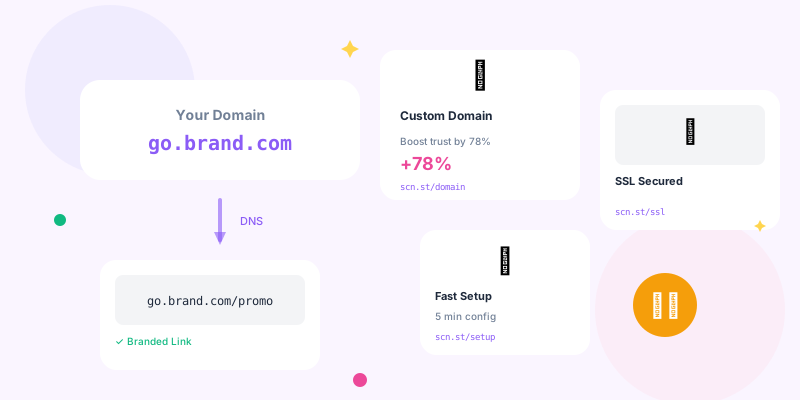
- If using custom domain: purchase domain and set up DNS
- Select link management platform (or build custom if enterprise)
- Establish naming conventions and create team documentation
- Set up SSL certificate and HTTPS redirects
- Configure your link management platform
- Create first batch of branded links for active campaigns
- Test all links across different devices and browsers
- Set up analytics integration
- Train all team members who create marketing content
- Update marketing templates to use branded links
- Create internal wiki or guide for link creation process
- Establish approval workflow if needed
- Gradually replace old generic links in evergreen content
- Update social media bios with branded links
- Monitor performance metrics vs. previous generic links
- Gather team feedback and optimize process
Common Mistakes to Avoid
Even with the best intentions, teams make predictable mistakes when implementing branded links. Here's what to watch out for:
Mistake 1: Inconsistent Implementation
Some team members use branded links, others don't. Some campaigns get branded links, others get generic. This creates confusion and dilutes the brand building effect. Solution: Make it the default, enforced by tools and process.
Mistake 2: Poor Slug Naming
Using random characters or abbreviations that only make sense to your team. yourbrand.com/fy25-q1-em-wlc-01 is technically branded, but it's not human-readable. Keep slugs clear and descriptive.
Mistake 3: Broken Links
Creating branded links and then letting them break when you redesign your site or change destination URLs. Solution: Use a link management platform that lets you update destinations without changing the branded link.
Mistake 4: No Analytics
Creating beautiful branded links but not tracking their performance. You're missing the entire point. Every branded link should feed into your analytics platform.
Mistake 5: Overly Long Slugs
Yes, descriptive is good. But yourbrand.com/spring-summer-2025-new-collection-launch-phase-1 defeats the purpose of a short link. Find the balance.
Measuring Success: Metrics That Matter
How do you know if your branded link strategy is working? Track these metrics:
- Click-Through Rate: Compare branded vs generic shorteners (expect 25-40% lift)
- Conversion Rate: Track full funnel from click to conversion
- Share Rate: How often do people reshare your branded links?
- Bounce Rate: Lower bounce indicates better trust and expectation matching
- Time on Site: Users from branded links should engage longer
- Brand Search Volume: Long-term indicator of brand awareness building
- Cost Per Acquisition: Should decrease as CTR and conversion improve
The Long Game: Compound Effects of Brand Building
Here's what most articles about branded links miss: the real value isn't in this month's campaign. It's in the compound effect over years.
Every branded link you share is a small deposit in your brand equity bank. Individually, each deposit is tiny. But over 12 months, sharing 1,000 branded links that each get seen by an average of 500 people means 500,000 brand impressions. Over 5 years? 2.5 million impressions from links alone.
These impressions build familiarity. Familiarity builds trust. Trust drives the entire marketing funnel. When someone finally enters your funnel as a prospect, they're not starting from zero—they've seen your brand hundreds of times through your links.
Your branded links can be several of those touchpoints, essentially giving you free brand impressions every time you share content.
Conclusion: Stop Leaving Brand Equity on the Table
Here's the bottom line: you're already sharing links. Every single one is either building your brand or wasting an opportunity. Generic shorteners are wasted opportunities. Branded links are brand building.
The investment is minimal—either free (if using your existing domain) or under $500/year for a custom short domain and link management platform. The return is massive: 39% higher CTR, better conversion rates, millions of brand impressions, and compound trust building over time.
Your competitors are either already using branded links (in which case you're behind) or they're not (in which case you have a chance to get ahead). Either way, the time to implement is now.
Stop leaving clicks on the table with generic shorteners. Stop wasting brand impression opportunities. Start building trust today with branded links that represent your brand professionally, perform better across every metric, and compound in value over time.
Your brand deserves better than bit.ly/a3f8kp2. Give it the professional, trustworthy, brand-building links it needs to succeed.