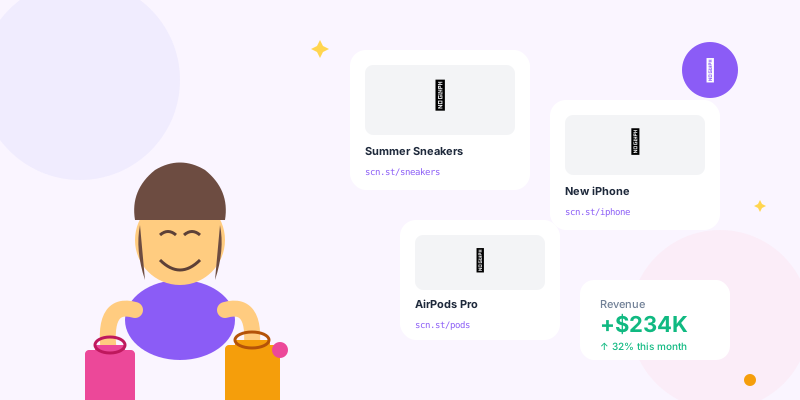
Creator Economy Link Strategy: Turn Your Audience Into Revenue With Smart Links
Sponsorships, affiliates, digital products, coaching — creators monetize through links. But most are leaving 60% of their revenue on the table with sloppy link setups. Here's the full link infrastructure stack for serious creators.

The creator economy is a link economy. Every revenue stream — brand deals, affiliate commissions, course sales, membership signups, merchandise — flows through a URL. How you manage, track, and optimize those links determines how efficiently you convert your audience into income. Most creators treat links as an afterthought. The ones consistently earning more treat them as infrastructure.
The Creator Revenue Stack: Which Links You Actually Need
Mapping Your Revenue to Link Types
Sponsorship Link Infrastructure
The Professional Sponsor Link Setup
When a brand is paying you $5,000 for a mention, they expect a click report. Here's how to deliver one that builds trust and justifies renewals:
[your-handle]-[brand]-[platform]-[content-id]
Examples:
scn.st/yourcreator-nord-yt-ep142— NordVPN sponsorship, YouTube, episode 142scn.st/yourcreator-squarespace-ig-mar26— Squarespace, Instagram, March 2026scn.st/yourcreator-skillshare-pod-s3e8— Skillshare, podcast, S3E8
- Clean click report per deliverable (not combined across all their campaigns)
- Proof of performance with timestamps and geographic breakdown
- Negotiation data: "Your March campaign got 3,400 clicks at $1.47 CPC — industry benchmark is $2.10"
- Historical data to increase rates: show year-over-year click growth
Affiliate Link Strategy for Creators
From Messy to Managed: The Affiliate Link System
https://tracking.partner.io/aff_c?offer_id=1234&aff_id=56789&source=email
Fixed: scn.st/tool-name
Why it matters: Short links are 34% more likely to be clicked than raw affiliate URLs in content.
Problem 2: You can't link from everywhere
YouTube descriptions, podcast show notes, Instagram captions, email newsletters — some platforms strip or truncate long URLs. Short links work everywhere.
Fixed: One short link shared in every channel. Update the destination once if the affiliate URL changes.
Problem 3: No independent click tracking
Network says 200 clicks. Your content got 50,000 views. Something doesn't add up. With your own short link wrapping the affiliate URL, you have a second source of truth.
Fixed: Compare your short link clicks vs network-reported clicks. A 10%+ discrepancy is worth investigating.
Building Your Affiliate Link Library
// Recommended affiliate link naming structure
Creator handle: "maya"

// Tools / Software
scn.st/maya-notion      → Notion affiliate link
scn.st/maya-figma       → Figma affiliate link
scn.st/maya-canva       → Canva affiliate link

// Physical products
scn.st/maya-camera      → Camera affiliate link (Amazon)
scn.st/maya-desk        → Standing desk affiliate link
scn.st/maya-mic         → Microphone affiliate link

// Courses / Learning
scn.st/maya-skillshare  → Skillshare affiliate link
scn.st/maya-masterclass → Masterclass affiliate link

// Note: Same link works across YouTube description,
// podcast notes, bio page, and email newsletter.
// Update destination once if affiliate URL changes.Content-to-Revenue Attribution
Knowing Which Content Actually Makes You Money
This is the insight most creators never get: which videos, posts, and episodes actually drive revenue — not just views.
// Bio page links with UTM attribution
Product link from TikTok bio:
scn.st/maya-course → /course?utm_source=tiktok&utm_medium=bio&utm_content=main-cta

Product link from YouTube description:
scn.st/maya-course-yt → /course?utm_source=youtube&utm_medium=description&utm_campaign=tutorial-series

Product link from email newsletter:
scn.st/maya-course-em → /course?utm_source=email&utm_medium=newsletter&utm_campaign=weekly- TikTok drives 60% of course clicks but only 20% of purchases
- Email drives 15% of clicks but 40% of purchases
- YouTube tutorial descriptions convert 3x better than YouTube community posts
Platform-Specific Link Strategy
YouTube: Multi-Link Opportunity
Podcast: Show Notes Architecture
Creator Link Analytics Workflow
The Weekly Creator Revenue Audit
- Total clicks across all revenue links this week vs last week
- Any sponsor links with unusually low clicks? (Check the content is live and the link isn't broken)
- Top 3 affiliate links by clicks this week — are they the ones generating revenue?
- Click-to-revenue ratio by affiliate program — which has best commission efficiency?
- Which platform drives the most revenue per click (YouTube vs TikTok vs email)?
- Content correlation: which video/episode drove the highest affiliate click spike?
- Update affiliate link destinations if programs changed terms or URLs
- Drop affiliate programs that generate under $50/quarter regardless of clicks (not worth mental overhead)
- Increase promotion of programs with highest revenue-per-click
- Review all link slugs for anything confusing or outdated
- Archive or redirect links from campaigns that ended
The Creator Link Audit Checklist
- ✅ Every sponsorship has its own tracking link with sponsor name in slug
- ✅ All affiliate URLs wrapped in short links with your brand prefix
- ✅ Digital product links are evergreen and never break (dynamic links)
- ✅ Bio page links have UTM parameters for platform attribution
- ✅ YouTube description has short links for all affiliate tools mentioned
- ✅ Podcast show notes use spoken-friendly vanity URLs
- ✅ Post-campaign click reports sent to sponsors within 48 hours
- ✅ Weekly click check to catch broken links before they cost you commissions
- ✅ Quarterly affiliate program review with revenue-per-click analysis
- ✅ Master list of all affiliate links, programs, and commission rates maintained
Conclusion
The creators who consistently earn more aren't necessarily creating better content. They're systematically capturing more value from every piece of content they publish. A branded tracking link on every affiliate mention, a professional click report to every sponsor, and a bio page that converts at 10%+ instead of 3% — these aren't glamorous optimizations, but they compound dramatically over a career.
Your audience is already there. Your content is already earning attention. Smart link infrastructure is what converts that attention into revenue you can see, measure, and grow.