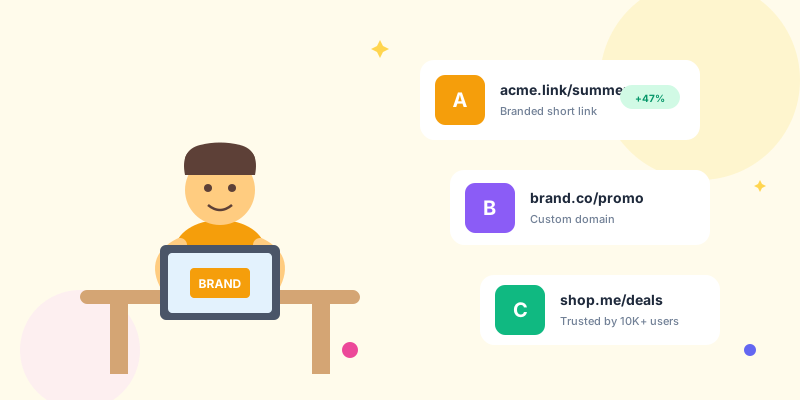
Custom Slug Strategy: Why scn.st/summer-sale Beats scn.st/x7K9mP
Random slugs like x7K9mP are forgettable, unprofessional, and impossible to share verbally. Learn how to create custom slugs that people remember, trust, and actually use.

Your short link's slug is the difference between memorability and oblivion. Between professional and amateur. Between "I'll check that out" and "wait, what was that link again?"
Random slugs (bit.ly/3xK7pL9, tinyurl.com/y8x2md4p) were acceptable when URL shorteners were new. In 2025, they're a red flag. They scream "I didn't care enough to create a real link." They're impossible to share verbally. They look like spam.
Why Custom Slugs Matter
The Trust Factor
Which link would you click?
Option A: bit.ly/3xK7pL9
Option B: yourbrand.link/free-template

Option A signals:
• Random, automated
• Could go anywhere
• No context
• Possible spam

Option B signals:
• Intentional, curated
• Clear destination
• Contextual
• Professional brand
The Memorability Factor
Podcast mention:
Bad: "Visit bit dot ly slash 3 x K 7 p L 9"
Listener thinks: "I'll never remember that"
Result: Lost opportunity

Good: "Visit yourbrand dot link slash podcast"
Listener thinks: "I can remember that"
Result: Actual traffic
Bad: Business card with "tinyurl.com/y8x2md4p"
Reader thinks: "I'm not typing that"

Good: Business card with "yourbrand.link/contact"
Reader thinks: "Simple, I'll check it out"
The Professionalism Factor
Which brand seems more professional?
Brand A email signature:
Connect with me: bit.ly/abc123
View my portfolio: tinyurl.com/xyz789

Brand B email signature:
Connect with me: sarah.link/linkedin
View my portfolio: sarah.link/portfolio

Brand B looks more professional, more established, more trustworthy.
- Intentionality: You cared enough to name this link properly
- Professionalism: You're not using free tools with random output
- Brand consistency: Links match your brand voice and standards
- User respect: You made it easy for users to remember and share
- Transparency: Users can guess where the link goes before clicking
Custom Slug Naming Principles
Principle 1: Make It Readable
Bad slugs:
yoursite.link/SUMR-SLE-25
yoursite.link/promo_offer_2025_q4
yoursite.link/LnkTmplte
- Abbreviations are ambiguous (SUMR = summer or summary?)
- Underscores are hard to spot in underlined links
- Mixed case is confusing (is it case-sensitive?)
yoursite.link/summer-sale
yoursite.link/promo-2025
yoursite.link/template
- Full words (no ambiguity)
- Hyphens for readability
- All lowercase (no confusion)
Principle 2: Keep It Short (But Not Too Short)
Too short (ambiguous):
yoursite.link/s (sale? summer? spring? signup?)
yoursite.link/p (product? pricing? promo?)
yoursite.link/t (template? terms? trial?)
yoursite.link/complete-guide-to-email-marketing-2025
yoursite.link/ultimate-beginner-friendly-tutorial
yoursite.link/get-30-percent-off-your-first-order
yoursite.link/email-guide
yoursite.link/tutorial
yoursite.link/first-order
Principle 3: Make It Descriptive
Users should know where they're going:
yoursite.link/template → Probably a template
yoursite.link/pricing → Probably pricing page
yoursite.link/demo → Probably a demo or demo request
yoursite.link/podcast → Probably podcast-related content
yoursite.link/amazing (what's amazing?)
yoursite.link/check-this (check what?)
yoursite.link/click-here (where does it go?)
Principle 4: Use Hyphens (Not Underscores or Spaces)
Why hyphens are better:
With hyphens: yoursite.link/summer-sale
• Visually separates words
• Standard convention
• Works in all contexts

With underscores: yoursite.link/summer_sale
• Underscore hidden when link is underlined
• Harder to see visually
• Less common convention

With spaces: yoursite.link/summer%20sale
• Encoded as %20 (ugly)
• Harder to type
• Looks unprofessional
Principle 5: Avoid Special Characters
Don't use:- Exclamation marks: yoursite.link/sale!
- Question marks: yoursite.link/interested?
- Ampersands: yoursite.link/tips&tricks
- Percent signs: yoursite.link/50%off
- Symbols: yoursite.link/@handle
- yoursite.link/sale-now
- yoursite.link/interested
- yoursite.link/tips-and-tricks
- yoursite.link/50-off
- yoursite.link/handle
Slug Naming Strategies by Use Case
For Campaigns
Structure: [channel]-[campaign]-[variant]
yoursite.link/email-summer-sale
yoursite.link/social-summer-sale
yoursite.link/sms-summer-sale

yoursite.link/email-webinar-tech
yoursite.link/email-webinar-marketing
- Clear channel attribution
- Easy to track campaign performance
- Organized naming system
- Scalable as campaigns grow
For Content
Structure: [content-type] or [topic]
yoursite.link/guide
yoursite.link/template
yoursite.link/checklist
yoursite.link/video

yoursite.link/seo-guide
yoursite.link/email-template
yoursite.link/sales-checklist
yoursite.link/tutorial-video
- Immediately clear what type of content
- Easy for users to remember
- Works for evergreen content
- Can be shared verbally
For Products
Structure: [product-name] or [category]-[product]
yoursite.link/pro-plan
yoursite.link/enterprise
yoursite.link/starter

yoursite.link/shoes-nike-air
yoursite.link/laptop-macbook-pro
- Direct and clear
- Good for product launches
- Easy to say in presentations
- Can be used in ads
For Events
Structure: [event-name] or [event]-[date]
yoursite.link/webinar
yoursite.link/conference-2026
yoursite.link/summit-march

yoursite.link/webinar-jan-15
yoursite.link/workshop-feb
- Time-specific
- Clear purpose
- Easy registration URLs
- Can be promoted verbally
For Social Media
Structure: [platform] or [platform]-[campaign]
yoursite.link/instagram
yoursite.link/tiktok
yoursite.link/linkedin

yoursite.link/ig-reel-summer
yoursite.link/tt-tutorial
yoursite.link/li-article
- Platform-specific tracking
- Easy to update bio links
- Clear context
- Platform abbreviations save characters
- ig: Instagram
- tt: TikTok
- tw: Twitter/X
- fb: Facebook
- li: LinkedIn
- yt: YouTube
- pin: Pinterest
For Seasonal Offers
Structure: [season/holiday]-[offer]
yoursite.link/black-friday
yoursite.link/cyber-monday
yoursite.link/summer-sale
yoursite.link/holiday-deals

yoursite.link/bf-early-access
yoursite.link/cm-flash-sale
- Time-bound clarity
- Reusable year after year (or create bf-2025, bf-2026)
- Easy to promote
- Instantly recognizable
For Podcast Episodes
Structure: [podcast]-[episode] or [ep]-[number]
yoursite.link/podcast-ep47
yoursite.link/show-247
yoursite.link/ep-100

yoursite.link/ep47-email-tips
yoursite.link/ep48-seo-guide
- Easy to say on air: "Visit yoursite.link/ep47"
- Sequential organization
- Can include topic for clarity
- Episode-specific tracking
Advanced Slug Strategies
Strategy 1: Vanity Slugs for Brand Terms
Reserve your core brand terms:
yoursite.link/about
yoursite.link/contact
yoursite.link/pricing
yoursite.link/features
yoursite.link/blog
yoursite.link/careers
yoursite.link/support
- Email signatures
- Business cards
- Print materials
- Presentations
- Anywhere you need simple, memorable URLs
Strategy 2: Action-Oriented Slugs
Instead of noun-based, use verb-based:
Noun-based (passive):
yoursite.link/demo
yoursite.link/trial
yoursite.link/signup

Action-oriented (active):
yoursite.link/get-demo
yoursite.link/start-trial
yoursite.link/join-now
- More engaging
- Clear call-to-action
- Higher psychological trigger
- Feels more intentional
Strategy 3: A/B Testing Slugs
Test different slug styles:
Test A: yoursite.link/download
Test B: yoursite.link/get-free-template

Test A: yoursite.link/pricing
Test B: yoursite.link/see-pricing

Measure:
• Click-through rate
• Conversion rate
• Sharing rate (how often users share the link)
Strategy 4: Slug Hierarchies
Create logical groupings:
Resource category:
yoursite.link/resources → Main resource hub

Specific resources:
yoursite.link/guide-email
yoursite.link/guide-seo
yoursite.link/guide-social

yoursite.link/template-email
yoursite.link/template-sales
yoursite.link/template-report
- Organized structure
- Easy to remember patterns
- Scalable system
- Clear categorization
Strategy 5: Time-Stamped Slugs (For Recurring Events)
Annual events:
yoursite.link/summit-2025
yoursite.link/summit-2026
yoursite.link/summit-2027

OR

yoursite.link/summit (always redirects to current year)
yoursite.link/summit-archive (past years)
yoursite.link/webinar-jan
yoursite.link/webinar-feb
yoursite.link/webinar-mar
- Clear which version/date
- Archive old content
- Reusable naming pattern
- No confusion
Slug Naming Mistakes to Avoid
Mistake #1: Using Generic Words
Too generic:
yoursite.link/link
yoursite.link/page
yoursite.link/site
yoursite.link/here
yoursite.link/click
- No context
- Could mean anything
- Not memorable
- Wastes opportunity
- Use specific, descriptive terms
- Give context about destination
- Make it meaningful
Mistake #2: Making It Too Long
Too long:
yoursite.link/complete-comprehensive-guide-to-email-marketing-for-beginners-2025
- Hard to remember
- Hard to type
- Hard to say verbally
- Defeats purpose of "short" link
yoursite.link/email-guide
Mistake #3: Using Ambiguous Abbreviations
Ambiguous:
yoursite.link/WS (webinar? workshop? winter sale? website?)
yoursite.link/PM (product? pricing? promo? project?)
yoursite.link/GA (Google Analytics? general admission? get access?)
- Multiple interpretations
- Confusion
- Looks lazy
- Spell out key terms
- Use widely recognized abbreviations only
- Be explicit
Mistake #4: Copying Your Page Title Exactly
Page title: "The Complete Beginner's Guide to Email Marketing in 2025" Bad slug:
yoursite.link/the-complete-beginners-guide-to-email-marketing-in-2025
yoursite.link/email-guide
OR
yoursite.link/beginner-email-guide
Mistake #5: Not Checking Availability
Problem: You want yoursite.link/sale but it's already taken (by an old campaign you forgot about) Solution:- Check before planning campaigns
- Document all slugs in a central system
- Consider adding year/version if core slug is taken
- yoursite.link/sale-2025 instead of giving up
Slug Management Best Practices
Practice 1: Document Everything
Create a slug inventory:
Slug | Destination | Created | Campaign | Status
-----|-------------|---------|----------|-------
summer-sale | /sales/summer | 2025-06-01 | Summer 2025 | Active
email-guide | /guides/email | 2025-01-15 | Evergreen | Active
webinar-jan | /webinar | 2025-01-10 | Jan Webinar | Expired
- Prevent duplicate slugs
- Track what's used
- Retire old slugs
- Maintain consistency
Practice 2: Use Naming Conventions
Establish rules:
All slugs:
• Lowercase only
• Hyphens for spaces
• No special characters
• 2-3 words max
• Descriptive and clear

Campaign slugs:
• Format: [channel]-[campaign]-[variant]
• Example: email-summer-a

Content slugs:
• Format: [type]-[topic]
• Example: guide-seo
Practice 3: Review and Retire
Quarterly slug audit: 1. Review all active slugs 2. Identify unused/old slugs 3. Retire outdated campaigns 4. Update redirects if content moved5. Document changes
Don't let slugs accumulate forever—clean up regularly.Practice 4: Test Before Launch
Pre-launch checklist:- [ ] Slug is available
- [ ] Slug is spelled correctly
- [ ] Slug makes sense out of context
- [ ] Slug can be said verbally clearly
- [ ] Slug redirects to correct destination
- [ ] Slug is documented in inventory
Conclusion
Your short link's slug is marketing real estate.Every slug is an opportunity to be memorable, professional, and clear. Random character strings waste that opportunity. Custom slugs seize it.
Your action plan: This week:- Audit your current slugs
- Replace random slugs with custom slugs for active campaigns
- Document your slug naming conventions
- Reserve vanity slugs for core brand terms
- Create slug inventory system
- Train team on naming conventions
- A/B test action-oriented vs. noun-based slugs
- Implement slug approval process
- Retire old/unused slugs
Stop using x7K9mP. Start using summer-sale. Your click-through rates will thank you.