Link-in-Bio Advanced Strategies: Turn 1 Link into 10,000 Tracked Conversions
Instagram gives you one clickable link. You have 47 things to promote. Most people create a basic link page with 47 links and wonder why nothing converts. Learn the advanced strategies that turn one link into a conversion machine.
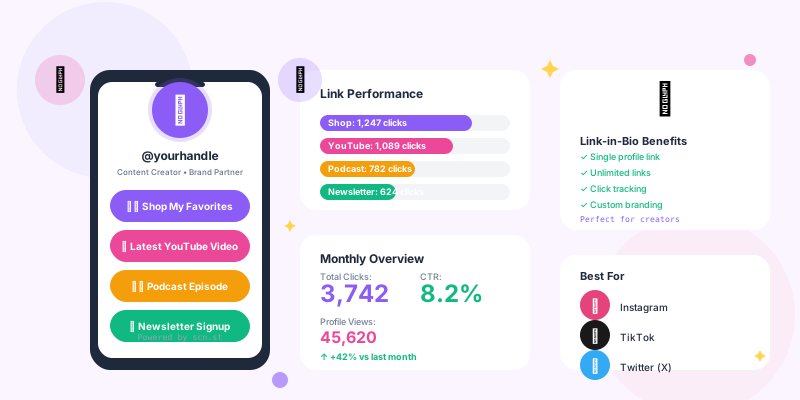
The link-in-bio has become one of the most valuable pieces of digital real estate. It's the only clickable link on Instagram. The gateway from TikTok to your website. The bridge from social to sales.
But most link-in-bio pages are digital junkyards: 30 links stacked vertically, no prioritization, no strategy, no conversion optimization. Just a dump of every link you might want someone to click.
Why Most Link-in-Bio Pages Fail
The Common Mistakes
The Link Graveyard (too many options):
Typical link-in-bio page:
1. Shop Now
2. New Collection
3. Blog
4. YouTube Channel
5. TikTok
6. Podcast
7. Newsletter
8. About Us
9. Contact
10. Instagram (wait, they're already on Instagram)
11. Facebook
12. Twitter
13. LinkedIn
14. Free Guide
15. Webinar
... [30 more links]

Problem: Decision paralysis
Too many choices = No choice made
Visitor behavior: Scroll, overwhelmed, leave

Conversion rate: 1-3%
Every visitor sees identical page:
- Same links regardless of how they found you
- Same order regardless of what they're interested in
- Same messaging regardless of their journey stage

Problem: Irrelevant to most visitors
Someone who found you from product post sees blog link first
Someone interested in blog sees shop link first
Misalignment = Low conversions

Conversion rate: 2-4%
Link-in-bio set up 6 months ago:
- Links to products no longer available
- Promotes sale that ended 3 months ago
- References seasonal content from last year
- Dead links (404 errors)

Problem: Outdated, unprofessional, broken
Visitor trust: Zero
Conversion rate: 1-2%
Advanced Strategy #1: The Priority Stack
Limit to 3-5 Primary Actions
The psychology of choice:
Scientific finding (Paradox of Choice):
• 3 options: 60% make a choice
• 10 options: 40% make a choice
• 30 options: 12% make a choice

More options = Lower conversion rate
Position 1 (Hero): Primary conversion goal
• What you want MOST people to do
• Largest button, prominent placement
• Clear value proposition
Example: "Shop New Collection - 40% Off"

Position 2-3 (Supporting): Secondary goals
• Complimentary to primary goal
• Smaller but still prominent
Examples: "Read Customer Reviews", "Watch Product Video"

Position 4-5 (Catch-all): Everything else
• Low-priority but still useful
• Smaller links or "More" dropdown
Examples: "About Us", "Contact", "Other Products"

Hidden (Below fold): Social links, legal, etc.
• Only for people actively looking
Examples: Other social profiles, terms, privacy
Before (30 links, 1.8% CTR):
[All 30 links displayed equally]

After (Priority Stack, 8.2% CTR):
🔥 Shop Winter Sale - 40% Off [LARGE BUTTON]
📦 Free Shipping Over $50 [Medium button]
⭐ 10,000+ 5-Star Reviews [Medium button]
... More Links (dropdown)
   - Blog
   - About Us
   - Gift Cards
   - Contact

Result:
• 4.6x increase in clicks
• 3.2x increase in conversions
• 71% of clicks go to primary CTA
Advanced Strategy #2: Dynamic Bio Linking
Change Links Based on Content
The problem with static bio links:
You post about new product → Bio links to homepage
You post about blog article → Bio links to homepage
You post about sale → Bio links to homepage
You post about webinar → Bio links to homepage

Result: Misalignment between post and link
Visitor expectation: Link to thing you just posted about
Reality: Generic homepage
Outcome: Confusion, friction, drop-off
Post about product → Update bio link to product page
Post about blog → Update bio link to that article
Post about sale → Update bio link to sale landing page
Post about webinar → Update bio link to registration

Alignment: 100%
Visitor experience: Seamless
Conversion rate: 3-5x higher
Every time you post:
1. Update top link on bio page to match post
2. Use clear CTA: "👆 Link to shop this post"
3. Update within 5 minutes of posting

Pros: Simple, free, full control
Cons: Manual work, easy to forget
Best for: Small accounts (<50K followers)
Use link-in-bio tools with automation:
• Later: Auto-post + auto-update bio link
• Linktree: Dynamic content blocks
• Custom solution: API-driven link updates

Workflow:
1. Schedule post in Later with product tag
2. Later auto-publishes to Instagram
3. Later auto-updates bio link to product
4. Bio link matches post automatically

Pros: Fully automated, scalable
Cons: Requires tool/setup
Best for: Larger accounts (50K+ followers) or agencies
Advanced Strategy #3: Smart Link Routing
Send Different Audiences to Different Destinations
The segmentation opportunity:
Not all visitors are equal:
• First-time visitor (never bought, need education)
• Past customer (already trust you, ready to buy again)
• Email subscriber (engaged, need specific offer)
• High-intent (came from product post, ready to buy)

One-size-fits-all link: 2-3% conversion
Segmented links: 8-12% conversion (4x better)
Create unique bio link for each traffic source:

Instagram story: yoursite.com/bio?source=story
Instagram post: yoursite.com/bio?source=feed
TikTok: yoursite.com/bio?source=tiktok
YouTube: yoursite.com/bio?source=youtube

Server-side routing logic:
if (source === 'story') {
  // Stories are impulse-driven, show limited-time offer
  redirect('/flash-sale')
} else if (source === 'feed') {
  // Feed posts are discovery, show best-sellers
  redirect('/popular-products')
} else if (source === 'tiktok') {
  // TikTok audience is younger, show trending items
  redirect('/trending')
}

Result: Personalized landing page for each source
First visit (no cookie):
→ Show welcome message + product overview
→ Capture email with discount offer
→ Set cookie

Return visit (has cookie):
→ Skip welcome message
→ Show "Welcome back! Shop new arrivals"
→ Personalized recommendations based on previous behavior

Conversion lift: 2-3x on return visits
Monday-Thursday: Link to blog content (educational)
Friday-Sunday: Link to shop (weekend shopping behavior)

Flash sale active: Override all links to sale page
Product launch day: Override all links to new product

Use server-side logic or link management platform to automate
Advanced Strategy #4: Micro-Commitments
Break Journey into Smaller Steps
The direct-sale problem:
Typical flow:
Instagram post → Bio link → Product page → Buy now

Conversion rate: 0.5-1.5%

Why so low?
• Too big an ask (impulse buyer → $200 purchase)
• No trust building
• No value demonstration
• High friction
Step 1: Micro-commitment (low barrier)
Instagram post → Bio link → "Take 30-second quiz"

Step 2: Value delivery
Quiz results → "Here's your personalized recommendation"

Step 3: Soft pitch
"Based on your answers, we recommend Product X"
+ Social proof + Reviews + Limited offer

Step 4: Sale
"Add to cart" (now much higher intent)

Conversion rate: 6-12%

Why better?
• Lower initial barrier (quiz vs. buy)
• Value before ask (personalized results)
• Trust built through process
• Higher intent by the time they see price
Instead of: "Shop now"
Try:
• "Take our style quiz" → Recommended products
• "See if we ship to you" → Enter ZIP → "Yes! Shop now"
• "Watch 60-second product demo" → Video → CTA
• "Get 10% off" → Email capture → Personalized discount
Instead of: "Book a call"
Try:
• "See pricing for your situation" → 3 questions → Custom quote
• "Calculate your savings" → Simple calculator → Book call CTA
• "See case study" → Relevant example → "Want these results?"
• "Watch 2-minute demo" → Video → Calendar link
Instead of: "Read blog"
Try:
• "Get free template" → Email gate → Blog content
• "Take assessment" → Results → Related article
• "Play quick game" → Fun engagement → Content unlock
Advanced Strategy #5: Social Proof Integration
Reduce Friction with Trust Signals
The cold traffic problem:
Visitor journey:
Instagram (warm) → Bio link (cold landing page) → Shop (buying decision)

Trust at each stage:
Instagram: High (they follow you)
Bio page: Low (generic landing page)
Shop: Very low (asking for money)

Conversion rate: 1-2%
Add trust signals to bio page:

Before:
[Shop Now] ← Generic button, no context

After:
⭐⭐⭐⭐⭐ 4.9/5 from 10,000+ reviews
[Shop Now - Trusted by 50,000 Customers]
💬 "Best purchase I've made!" - Sarah J.
📦 Free shipping & 30-day returns

Trust signals: ✓
Social proof: ✓
Risk reversal: ✓

Conversion rate: 4-7%
⭐⭐⭐⭐⭐ 4.8/5 (12,483 reviews)

Why it works:
• Instant credibility
• Social validation
• Reduces perceived risk
💬 "This changed my life!" - Jennifer M.
💬 "Worth every penny" - Michael R.

Why it works:
• Real voices (not marketing copy)
• Relatable experiences
• Emotional connection
Trusted by 50,000+ happy customers
Join 100,000+ subscribers
500,000 products sold

Why it works:
• Bandwagon effect (everyone's doing it)
• Reduces fear of unknown
• Validates quality
As seen in: Forbes, TechCrunch, Vogue
Featured in: Oprah's Favorite Things

Why it works:
• Authority transfer
• Legitimacy signal
• Aspirational association
✓ Free shipping & returns
✓ 30-day money-back guarantee
✓ Lifetime warranty
✓ No credit card required

Why it works:
• Removes purchase objections
• Shows confidence in product
• Reduces perceived risk
Advanced Strategy #6: Analytics-Driven Optimization
Track, Test, Improve
What to track:
Bio link analytics:

Traffic metrics:
• Profile views (how many see bio)
• Bio link clicks (how many click)
• Click-through rate (% of viewers who click)

Engagement metrics:
• Which links get clicked most
• Where visitors drop off
• Time on bio page
• Return visitor rate

Conversion metrics:
• Bio click → Landing page visit
• Landing page → Add to cart
• Add to cart → Purchase
• Attribution: Which post drove sale?

Revenue metrics:
• Revenue per bio visitor
• Revenue per link click
• ROI by traffic source (Instagram vs TikTok)
Variant A: 3 links
Variant B: 8 links
Variant C: 20 links

Measure: Click-through rate
Hypothesis: Fewer links = Higher CTR

Run for: 2 weeks (minimum 1,000 visitors)

Expected result: 3-5 links outperforms 20 links
Variant A: "Shop Now"
Variant B: "Shop New Collection"
Variant C: "Shop 40% Off Sale"

Measure: Click-through rate + conversion rate
Hypothesis: Specific offer > Generic CTA

Expected result: Variant C (specific offer) wins
Variant A: Small blue button
Variant B: Large blue button
Variant C: Large red button

Measure: Click-through rate
Hypothesis: Larger + contrasting color = More clicks

Expected result: Variant C wins (size + contrast)
Variant A: Social proof above buttons
Variant B: Social proof below buttons
Variant C: No social proof

Measure: Click-through rate + conversion rate
Hypothesis: Social proof above = Higher trust = More clicks

Expected result: Variant A wins
Advanced Strategy #7: Platform-Specific Optimization
Instagram vs. TikTok vs. YouTube (Different Strategies)
Instagram bio link strategy:
Audience: Visual, discovery-focused, brand-conscious
Behavior: Browsing, exploring, impulse purchases

Bio link approach:
• Visual grid layout (matches Instagram aesthetic)
• Product-focused (shoppable posts)
• Story highlights integration (swipe up for Story links)
• Frequent updates (match latest post)

Best practices:
✓ Update bio link within 5 min of posting
✓ Use "Link in bio 👆" in captions
✓ Story stickers: "Swipe up" or "Link in bio"
✓ Highlight key links in Story Highlights
Audience: Young, trend-focused, entertainment-first
Behavior: Rapid consumption, meme culture, viral trends

Bio link approach:
• Simple, direct (one primary CTA)
• Trending offers (match current viral trends)
• Video-first landing pages (not static)
• Urgent CTAs (FOMO, limited time)

Best practices:
✓ Bold, attention-grabbing copy
✓ Mobile-first design (100% of traffic is mobile)
✓ Fast-loading pages (<2 seconds)
✓ Video on landing page (matches TikTok experience)
Audience: Research-focused, longer attention span, educational
Behavior: Deep dives, comparisons, informed decisions

Bio link approach:
• Educational resources (guides, tutorials)
• Product comparisons (help decision-making)
• Longer-form landing pages (they'll read)
• Multiple related links (playlists, resources)

Best practices:
✓ Match video content (link to what video discusses)
✓ Timestamps in description (link to specific moments)
✓ Playlists as link categories
✓ Pinned comment with links
Audience: Professional, B2B, career-focused
Behavior: Networking, learning, business decisions

Bio link approach:
• Professional landing page (not flashy)
• Case studies and whitepapers (data-driven)
• Lead gen focused (demo, consultation, download)
• Credibility signals (certifications, awards)

Best practices:
✓ Professional design (clean, corporate)
✓ Clear value proposition (business benefits)
✓ Social proof (client logos, testimonials)
✓ Low-friction lead capture (no hard sell)
Advanced Strategy #8: Retargeting from Bio Link
Don't Lose Visitors Who Don't Convert
The lost visitor problem:
10,000 profile visitors
300 click bio link (3%)
30 convert (10% of clickers, 0.3% overall)

Lost: 9,970 people who didn't convert
Question: How do you re-engage them?
Step 1: Install tracking pixels on bio link page
• Facebook Pixel (retarget on Facebook/Instagram)
• Google Ads Tag (retarget on Google Display Network)
• TikTok Pixel (retarget on TikTok)

Step 2: Create custom audiences
• Visited bio link but didn't click
• Clicked link but didn't convert
• Clicked specific product link (high intent)

Step 3: Retarget with relevant ads
Segment 1 (visited but didn't click):
→ Show brand awareness ads
→ Message: "You visited us! Here's what we're about"

Segment 2 (clicked but didn't convert):
→ Show product ads with social proof
→ Message: "Still thinking about it? Here's what others say"

Segment 3 (high intent, added to cart but didn't buy):
→ Show abandoned cart ads with incentive
→ Message: "Complete your order - get 10% off"

Result: 20-30% of "lost" visitors convert via retargeting
Advanced Strategy #9: Seasonal Rotation
Keep Bio Link Fresh and Relevant
The stale link problem:
Set bio link once → Never update
Promotes summer sale in December
Links to sold-out products
References events from 6 months ago

Result: Unprofessional, outdated, low trust
January: New Year sale + Fresh start messaging
February: Valentine's Day products
March: Spring collection launch
April: Spring break / Easter
May: Mother's Day
June: Father's Day + Summer start
July: Mid-summer sale + 4th of July
August: Back to school
September: Fall collection launch
October: Halloween
November: Black Friday / Cyber Monday prep
December: Holiday gift guide + End of year sale

Update bio link every 2-4 weeks minimum
Match current season, holiday, or promotion
Conclusion
Your link-in-bio isn't a link dump—it's your most valuable social media real estate.One link. That's all Instagram, TikTok, and most social platforms give you. Make it count.
Advanced link-in-bio strategy isn't about cramming 50 links onto one page. It's about:
- Prioritization (1-3 primary goals, not 50)
- Dynamism (update with every post, not once per year)
- Personalization (different links for different audiences)
- Conversion optimization (test, measure, improve)
- Audit current bio link page (how many links? When last updated?)
- Identify ONE primary goal (what do you want most people to do?)
- Implement Priority Stack (1 hero CTA, 2-3 supporting, hide rest)
- Set up dynamic bio linking (update with each post)
- Add social proof (reviews, testimonials, trust signals)
- Install tracking pixels (enable retargeting)
- A/B test bio link elements (copy, layout, CTAs)
- Implement smart routing (segment by source, behavior)
- Create seasonal rotation calendar (stay fresh)
- Measure revenue impact (track conversions from bio link)
New to link-in-bio pages? Start with the foundational guide on link-in-bio optimization and the 3-5-1 rule before applying these advanced strategies.
Stop treating your bio link like a junk drawer. Start treating it like the conversion machine it can be.
One link. Unlimited potential.