Link Management for Real Estate Agents: Track Every Listing Click from First View to Closed Deal
Real estate agents share dozens of listing links daily — across MLS, social, email, and yard signs — and have no idea which sources drive actual showings or offers. Smart link management changes that: every showing request traced to its source, every listing optimized based on real click data.
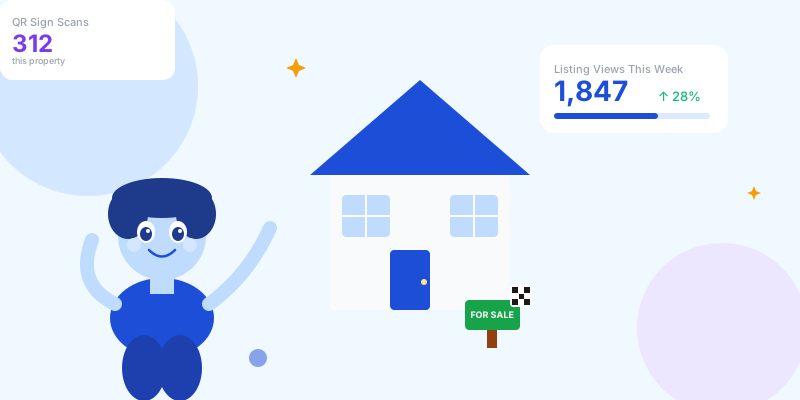
Real estate is a high-stakes, relationship-driven business where information asymmetry has always been an advantage. The agents who know which marketing channels generate qualified buyer leads — not just clicks, but actual showings and offers — can outmarket competitors who are spending the same budget in less effective places.
The Real Estate Link Architecture
One Listing, Multiple Tracked Entry Points
scn.st/123main-zillow     → listing + utm_source=zillow
scn.st/123main-realtor    → listing + utm_source=realtor
scn.st/123main-ig         → listing + utm_source=instagram
scn.st/123main-fb         → listing + utm_source=facebook
scn.st/123main-email      → listing + utm_source=email&utm_medium=newsletter
scn.st/123main-sign       → listing + utm_source=yardsign&utm_medium=qr
scn.st/123main-card → listing + utm_source=businesscard&utm_medium=printscn.st/123main, scn.st/456oak, scn.st/789elm-unit4. Memorable, searchable, and organizes your link library by property automatically.
What this unlocks after 90 days:
A data-driven answer to: "Which channel drives the most showing requests for properties in the $400K–$600K range?" You'll know whether Instagram organic, Facebook ads, or email campaigns are your most efficient channels — for that specific price bracket, in that specific neighborhood.
Yard Signs: Your Highest-Intent Traffic Source
scn.st/123main
What yard sign click data tells you:
→ Time of day of scans (morning drive-by commuters vs. weekend explorers)
→ Day of week pattern (weekday curiosity vs. weekend serious buyers)
→ Peak scan days after a price reduction (confirms buyers are re-evaluating at the new price)
→ Total sign engagement vs. total showings (your sign-to-showing conversion rate)
The neighborhood comparison:
If your yard signs on Oak Street get 3x more scans per day than similar listings on Pine Street, the Oak Street neighborhood generates more drive-by buyer interest — a data point useful for pricing strategy and marketing budget allocation.
Social Media Listing Strategy
scn.st/123main-ig via your bio link-in-bio page
→ Update your bio page to feature the current active listing prominently
→ Track which listing photos (exterior, kitchen, backyard) drive the most bio link clicks
→ Story swipe-ups (if eligible): use scn.st/123main-ig-story for separate tracking
Facebook:
→ Listing posts in local community groups: scn.st/123main-fbgroup
→ Paid Facebook/Instagram ads: scn.st/123main-fbad
→ Organic page posts: scn.st/123main-fbpage
→ Separating organic vs. paid vs. group tells you where organic engagement is worth the time
TikTok / Reels (property tours):
→ Bio link → link-in-bio page with active listings
→ Property tour video CTA: "Link in bio — scn.st/youragent-listings"
→ Track which video styles (cinematic tour, neighborhood highlight, price reveal) drive the most listing link clicks from your bio
LinkedIn (luxury or commercial real estate):
→ scn.st/123main-li — for professional network listing shares
→ Compare LinkedIn listing engagement vs. Instagram for price points above $1M (LinkedIn often outperforms for high-end properties because the buyer demographic skews professional)
Email Marketing for Listings
Subject: New Listing: 123 Main St — 3BR/2BA in Maplewood
CTA button: "View Full Listing" → scn.st/123main-email-new

UTM breakdown:
utm_source=email
utm_medium=newsletter
utm_campaign=new-listing-123main
utm_content=primary-cta-buttonscn.st/123main-email-pricecut
→ Compare click rate on this email vs. new listing announcement
→ Higher click rate on price cut emails tells you your initial price was above market perception — useful for the next comparable listing
Open house reminder emails:
scn.st/123main-email-openhouse
→ Separate from the listing page link — this goes to the open house registration or Google Maps directions
→ Track RSVP-to-attendance rate by tracking email clicks vs. actual attendees
Segmented buyer list emails:
Match listings to buyer criteria and send to matching segments only.
→ scn.st/123main-email-segment-3bd for buyers seeking 3-bedroom homes
→ Higher click rates from segmented sends vs. broadcast confirms your segmentation is working
The Open House Link Strategy
scn.st/123main-openhouse-rsvp
→ Track RSVPs by source (email vs. social vs. sign) to predict attendance
→ Directions link: scn.st/123main-directions → Google Maps direct link (saves typing the address)
During the open house:
→ Display a QR code inside the home for a digital information sheet
→ scn.st/123main-infosheet → PDF with specs, disclosures, neighborhood info
→ Visitors who scan this are engaged enough to want more information — high-intent signal
Post-open house follow-up email:
→ "Thanks for visiting" email with: scn.st/123main-followup
→ Click rate on follow-up email predicts offer likelihood — buyers who click are still actively considering
Agent contact link at the open house:
→ Your business card at the door: scn.st/youragent → your contact page or bio
→ Every visitor who scans = interested in you as their agent, not just the property
Tracking the Full Client Journey
Real Estate Link Management Checklist
- ✅ Every new listing gets a unique short link family (one per marketing channel)
- ✅ Yard signs have both QR code and text URL with property-specific slug
- ✅ Instagram bio updated to current featured listing on day of launch
- ✅ Email campaigns use separate links from social posts for the same listing
- ✅ Open house registration and information sheet have separate tracked links
- ✅ Business cards use personal agent short link (updateable destination)
- ✅ Lead source captured in CRM when contact form submitted via tracked link
- ✅ Monthly channel performance review: which source drives the most showings?
- ✅ Links updated or redirected when listing status changes (sold, under contract)
- ✅ Price reduction tracked by comparing pre/post click rates across channels
Conclusion
Real estate marketing without link tracking is like showing 10 homes without keeping notes — you'll forget what worked and repeat the same experiments with each new listing. The agents who build a link tracking habit early accumulate a proprietary data advantage: they know which channels convert in their market, which price brackets respond best to which platforms, and how long the typical buyer journey is before making an offer.
Start with your next listing. Create one short link per channel. After 90 days, you'll have the clearest picture of your marketing ROI you've ever had — and a data-driven case for exactly where to invest your next marketing budget.