Short Links in Print Marketing: Making Flyers, Business Cards, and Billboards Measurable
Print marketing has always had a measurement problem — you spend $2,000 on flyers and have no idea how many people actually responded. Short links and QR codes solve this entirely. Here's how to make every piece of print collateral as trackable as a Google Ad.
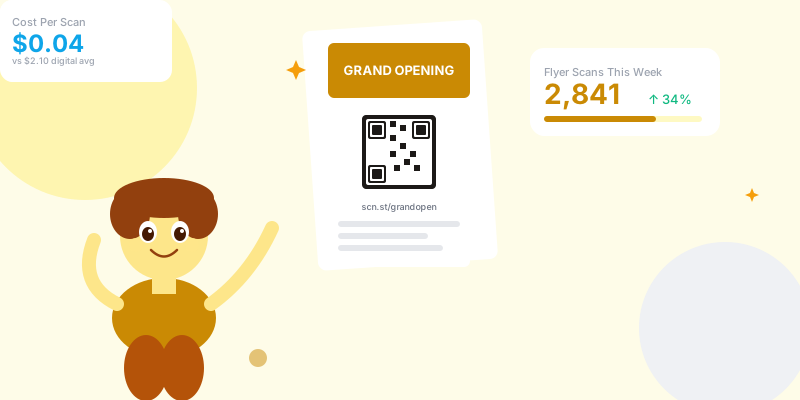
Print marketing — flyers, business cards, brochures, postcards, signage, billboards, trade show materials — reaches audiences that digital marketing misses. But marketers abandon it because they can't measure it. The solution isn't to ditch print. It's to embed a tracking mechanism in every printed piece, just as you would in every digital campaign.
The Two Print Tracking Tools: Short Links and QR Codes
Print-Specific Link Conventions
Naming Short Links for Physical Materials
scn.st/[brand]-[location]-[offer]
Examples:
→ scn.st/cafe-downtown-menu — downtown location menu
→ scn.st/cafe-uptown-menu — uptown location menu
→ Comparing both tells you which neighborhood has higher digital engagement with your print
For campaign-specific print (postcards, direct mail):
scn.st/[campaign]-[channel]
Examples:
→ scn.st/spring-sale-postcard — direct mail postcard
→ scn.st/spring-sale-flyer — in-store flyer
→ scn.st/spring-sale-window — window signage
→ Same offer, three print channels — now you know which format converts
For business cards:
scn.st/[name] or scn.st/[name]-card
→ Unique per person if team has multiple cards
→ Tracks how many people from your card-giving actually visit your site
→ Update destination without reprinting cards (new portfolio? New offer? Update the link.)
For trade show materials:
scn.st/[brand]-[show]-[year]
→ scn.st/company-ces-2026
→ Compare event-specific link performance across shows to rank ROI
Business Cards: The Underused Tracking Asset
scn.st/yourname
→ Links to your portfolio, bio page, or contact page
→ Analytics show how many people from your card-distribution actually visited
→ Geographic data shows which city/event your most engaged contacts are from
Sales team (10+ people):
→ Each rep gets a unique link: scn.st/firstname-lastname
→ Manager can see which rep's card drives the most website visits
→ Useful for identifying top-performing networkers vs. those who need coaching on follow-up
Department-specific cards:
→ scn.st/company-sales vs. scn.st/company-support
→ If sales cards drive 4x more website visits than support cards, your sales cards have a better pitch. What's on the sales card that isn't on support?
The "print once, never reprint" business card:
The most expensive mistake in business card design is printing a URL that becomes outdated. Using a short link means you can change the destination (new website, new offer, new portfolio) without reprinting 500 cards. One reprint run costs $150–$400. One short link update costs nothing.
Flyers and Direct Mail
scn.st/offer-downtown — flyers in downtown coffee shops
→ scn.st/offer-gym — flyers posted at local gyms
→ scn.st/offer-mail — direct mail to neighborhood
Compare click rates per estimated distribution size. If gym flyers drove 180 clicks from 500 distributed (36% response) and downtown coffee shops drove 40 clicks from 500 distributed (8% response), your next campaign budget allocation is obvious.
A/B testing print designs:
Run two flyer designs with different short links. Same distribution area, same quantity. Different headline, image, or offer framing. Which design drives more clicks? Print A/B testing has been impossible until short links made click tracking viable.
Billboards and Large-Format Signage
scn.st/trynow, scn.st/freequote, scn.st/joinus
Bad: scn.st/spring-special-offer, scn.st/getstarted2026
Time-delayed conversion tracking:
Billboard viewers don't immediately pull over and scan a QR code. They see the billboard on Monday, think about it for two days, and type the URL on Wednesday. Your analytics should show:
→ Time-of-day pattern of clicks (spikes during commute hours = billboard exposure time)
→ Day-of-week pattern (commute days vs. weekends)
→ Compare billboard placement dates vs. click volume growth
Measuring ROI on outdoor advertising:
Cost of billboard placement ÷ tracked clicks = cost per engagement.
Compare this CPE to your digital CPE. For high-conversion offers in high-traffic locations, billboards often outperform digital display advertising on a CPE basis — but you'd never know without the tracked link.
Trade Show and Event Materials
scn.st/yourcompany-ces) so you know post-show traffic came from the event
Event-specific analytics questions:
→ How many days after the event do you still get clicks? (Measures how long event interest lasts)
→ Which city do most post-show clicks come from? (Maps to attendee geography)
→ Did booth QR scans happen more on Day 1 or Day 2? (Informs booth staffing for next year)
Print Marketing Link Checklist
- ✅ Every print piece has a unique short link per location, format, or campaign
- ✅ Both QR code AND text URL printed (capture scanners and typers)
- ✅ Short link slug is speakable, memorable, under 20 characters
- ✅ Business cards use tracked short links (not raw homepage URL)
- ✅ Flyers in different locations use different short links for distribution comparison
- ✅ Billboard links are ultra-short and hyphen-free
- ✅ Trade show materials have event-specific short links
- ✅ Link destinations can be updated without reprinting (evergreen short links)
- ✅ Expiration date on short-term offer links to create urgency
- ✅ Print campaign results compared to digital CPE in same period
Conclusion
The print-vs-digital measurement gap is not inherent — it's a choice. Every piece of print collateral can be as measurable as any digital campaign, with one short link and a QR code. The businesses that implement this tracking consistently discover two things: their print campaigns are often more cost-effective than assumed, and the location-based data from print tells them things about their audience that digital data can't.
Make your next print run your most measured campaign ever. Create the short link first, print it second, and let the data tell you whether to do it again.