Multi-Channel Attribution: Stop Giving All Credit to Last Click
Last-click attribution lies to you. Most customers interact with 6-8 touchpoints before buying. Learn how to implement proper multi-touch attribution models.
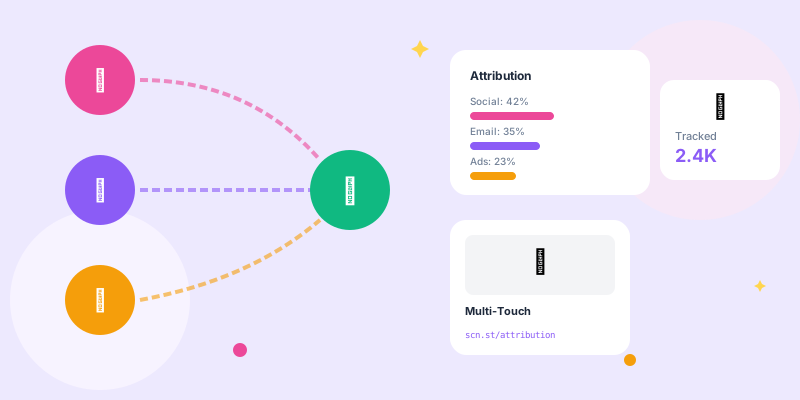
Last-click attribution is killing your marketing budget. It gives 100% credit to the final touchpoint while ignoring the entire journey that made the sale possible. Time to fix your attribution model.
Why Last-Click Attribution Fails
- Over-Values Bottom-Funnel: Direct and branded search get all the credit
- Under-Values Discovery: Top-funnel awareness campaigns look "worthless"
- Misallocates Budget: You kill effective campaigns that don't close deals directly
- Ignores Reality: Nobody sees one ad and immediately buys (except impulse purchases)
Real Customer Journey Example
Here's what actually happens:
- Day 1: Sees Instagram influencer post (awareness)
- Day 3: Sees Facebook retargeting ad (consideration)
- Day 5: Googles brand name, reads blog posts (research)
- Day 7: Opens marketing email, clicks to product page (interest)
- Day 10: Sees LinkedIn ad, doesn't click (reinforcement)
- Day 14: Direct traffic to website, makes purchase (conversion)
Last-click attribution gives "direct traffic" 100% credit and tells you to kill Instagram, Facebook, content, email, and LinkedIn. Terrible advice.
Attribution Model Types
Single-Touch Models (Flawed but Simple)
- Last Click: 100% credit to final touchpoint (under-values top funnel)
- First Click: 100% credit to first touchpoint (ignores nurture)
- Last Non-Direct Click: Ignores direct traffic (slightly better but still wrong)
Multi-Touch Models (Actually Useful)
- Linear: Equal credit to all touchpoints (simple, fair starting point)
- Time Decay: More credit to recent touchpoints (rewards closing tactics)
- U-Shaped (Position-Based): 40% to first, 40% to last, 20% to middle
- W-Shaped: Credit to first touch, middle conversion, last touch
- Data-Driven: Machine learning assigns credit based on actual contribution
Implementing Multi-Touch Attribution
What You Need to Track
- Every Touchpoint: Ads, emails, social posts, blog content, webinars
- Unique Identifiers: User IDs, cookie IDs, device fingerprints
- Timestamp Data: When each interaction occurred
- Channel Information: Source, medium, campaign for every click
- Conversion Events: Purchases, sign-ups, demos booked
- Cross-domain tracking (follow users across properties)
- User ID tracking (connect anonymous → authenticated)
- CRM integration (link marketing touches to sales outcomes)
- Data warehouse (store all touchpoint data)
- Attribution platform (calculate credit allocation)
Using UTM Parameters for Attribution
Consistent UTM tagging is critical:
- utm_source: Platform (facebook, google, newsletter)
- utm_medium: Channel type (cpc, social, email)
- utm_campaign: Specific campaign name
- utm_content: Ad variant or content piece
- utm_term: Keyword (for paid search)
Link Tracking for Attribution
- Create unique short links for every campaign and channel
- Track every click with complete context (source, user, time)
- Store click data in attribution warehouse
- Connect clicks to conversion events via user ID
- Calculate credit based on your chosen model
Short Links as Attribution Anchors
Short links provide perfect attribution tracking:
- Consistent Tracking: Works across all platforms (social, email, SMS, print)
- Redirect Chaining: Track multiple hops (Instagram → landing page → product page)
- Campaign Grouping: Organize links by campaign for easy analysis
- Real-Time Data: See touchpoint performance as it happens
Channel-Specific Attribution Insights
Paid Social (Facebook/Instagram/TikTok)
- Platform Claims: Facebook says it drove 100 conversions
- Multi-Touch Reality: Facebook assisted 100 but only closed 30
- Actual Value: Top-funnel awareness and remarketing, not direct conversion
- Budget Allocation: Fund for awareness, not just last-click conversions
Google Ads
Different ad types play different roles:
- Branded Search: High last-click attribution (people ready to buy)
- Non-Branded Search: Mid-funnel research touchpoint
- Display Ads: Awareness and remarketing (assists, rarely converts directly)
- YouTube Ads: Top-funnel education, shows value in multi-touch only
Content Marketing
Blog posts and content are attribution nightmares:
- Readers consume 3-7 pieces before considering purchase
- Last-click gives content zero credit (readers convert via other channels)
- Multi-touch reveals content's true value as trust-builder
- Time decay model under-values educational content consumed early
Email Marketing
- Users read on mobile, convert on desktop (cross-device tracking needed)
- Multiple emails in sequence (which one gets credit?)
- Long consideration cycles (email from 2 months ago still influential)
- Forward/share behavior (attribution breaks when emails are shared)
Cross-Device Attribution
Modern customers use 3-4 devices before purchasing:
- See Instagram ad on mobile (morning commute)
- Research on work desktop (lunch break)
- Read reviews on tablet (evening)
- Purchase on mobile (weekend)
- User Login: Track across devices when users authenticate
- Probabilistic Matching: Connect devices via behavior patterns
- Deterministic Matching: Device graphs from Google, Facebook
- Unified IDs: LiveRamp, The Trade Desk ID solutions
Attribution Windows
How far back should you look when assigning credit?
- E-commerce: 7-30 days (short consideration cycles)
- B2B SaaS: 30-90 days (longer sales cycles)
- Enterprise: 90-180 days (complex, multi-stakeholder decisions)
- Mobile Apps: 7-14 days (impulsive downloads)
Common Attribution Mistakes
- Only Tracking Paid Channels: Organic, referral, and direct matter too
- Ignoring Cross-Device: Mobile research → desktop purchase is common
- Short Attribution Windows: Missing early-stage touchpoints that matter
- Not Tracking Offline: QR codes, phone calls, in-store visits influence online purchases
- Siloed Data: Marketing and sales teams tracking separately
- Static Models: Attribution models should evolve as your business changes
Tools and Platforms
- Google Analytics 4: Free, data-driven attribution built-in
- HubSpot: Multi-touch attribution for inbound marketing
- Salesforce: CRM-integrated B2B attribution
- Segment: Customer data platform for unified tracking
- Adobe Analytics: Enterprise attribution with algorithmic models
- Ruler Analytics: Marketing attribution for agencies
Building Custom Attribution Models
For advanced needs, build custom models:
- Data Collection: Warehouse all touchpoint data (Snowflake, BigQuery)
- User Journey Mapping: Connect all interactions per user
- Model Definition: Define credit allocation rules
- Calculation: Run SQL queries or Python scripts to assign credit
- Visualization: Build dashboards (Tableau, Looker, Metabase)
- Iteration: Refine based on business outcomes
Interpreting Attribution Data
- Budget Allocation: Fund channels based on assisted conversions, not just last-click
- Campaign Strategy: Understand which campaigns work at each funnel stage
- Creative Testing: See which messages drive awareness vs conversion
- Customer Journey Optimization: Identify and fix drop-off points
- Channel Mix: Balance top-funnel, mid-funnel, bottom-funnel investments
Conclusion
Stop lying to yourself with last-click attribution. Your customers interact with multiple touchpoints before converting, and your budget allocation should reflect that reality.
Implement multi-touch attribution to see the full customer journey. Credit every touchpoint appropriately. Make smarter budget decisions. Grow faster with accurate attribution data instead of last-click fantasies.