SaaS Link Analytics: Track Every Click From Trial Signup to Paid Conversion
Your SaaS acquisition funnel has a data blind spot: you know where signups come from, but not which clicks led to paid conversions. Link analytics closes this gap — tracking the full journey from ad click to activated trial to upgraded customer, so you can optimize for revenue, not just signups.
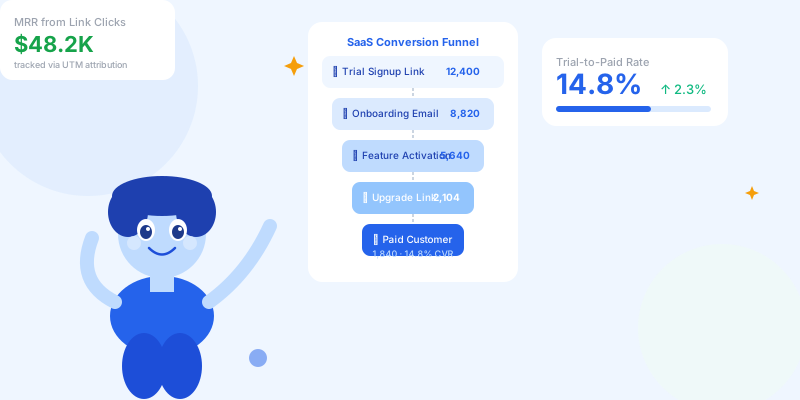
SaaS growth teams obsess over the right metrics: CAC, LTV, time-to-convert, churn. But the link layer — the clicks that start these journeys — is often the least instrumented part of the stack. A prospect clicks a LinkedIn ad, reads a blog post, watches a demo video, then starts a trial. Which touchpoint gets credit? With proper link tracking, you don't have to guess.
The SaaS Link Tracking Architecture
Mapping Every Acquisition Touchpoint
Paid search: scn.st/[product]-trial-gs  (Google Search)
Paid social: scn.st/[product]-trial-fb  (Facebook Ads)
             scn.st/[product]-trial-li  (LinkedIn Ads)
Content:     scn.st/[product]-trial-blog-[article]
Organic:     scn.st/[product]-trial-bio (Instagram/TikTok bio)
Referral:    scn.st/[product]-trial-ref-[partner]
Community:   scn.st/[product]-trial-ph  (Product Hunt)
scn.st/[product]-trial-hn (Hacker News)Welcome email CTA: scn.st/[product]-setup-email-welcome
Feature activation: scn.st/[product]-activate-[feature]
Onboarding checklist: scn.st/[product]-onboarding-step-[n]
Help docs: scn.st/[product]-docs-[topic]
Demo video: scn.st/[product]-demo-[feature]Upgrade CTA in-app: scn.st/[product]-upgrade-app-cta
Upgrade from email: scn.st/[product]-upgrade-email-trial-end
Pricing page: scn.st/[product]-pricing
Annual plan offer: scn.st/[product]-annual-offerThe Acquisition Attribution Model
First Touch vs. Last Touch vs. The Reality
scn.st/product-trial-li)
2. Lands on website, bounces without signing up
3. Searches Google for "best [category] tools" → finds your blog post → clicks internal CTA (tracked: scn.st/product-trial-blog-comparison)
4. Starts a trial
5. Uses the product for 5 days
6. Receives trial-ending email → clicks upgrade CTA (tracked: scn.st/product-upgrade-email-trial-end)
7. Upgrades to paid
Attribution options:
→ First touch: LinkedIn Ad gets 100% credit (drove the initial awareness)
→ Last touch: Trial-ending email gets 100% credit (drove the conversion action)
→ Linear: Each of 3 touches gets 33% credit
→ Time-decay: More credit to recent touches (email 50%, blog 30%, LinkedIn 20%)
→ Data-driven: Credit distributed based on statistical analysis of which touches correlate most strongly with conversion
The SaaS recommendation:
Use time-decay with first-touch reported separately. The acquisition channel (first touch) deserves credit for bringing in the prospect — but the conversion-triggering action is also important for onboarding optimization. Running both reports gives you the full picture.
Onboarding Link Analytics: Finding Your Activation Moments
Email 1 (Welcome): scn.st/product-setup-e1
→ "Complete your profile" → setup page
utm_content=email-1-setup-cta

Email 2 (Day 2): scn.st/product-feature1-e2
→ "Try [core feature]" → feature tutorial
utm_content=email-2-feature-cta

Email 3 (Day 4): scn.st/product-explore-e3
→ "See what else [Product] can do" → feature gallery
utm_content=email-3-explore-cta

Email 4 (Day 7): scn.st/product-upgrade-e4
→ "Your trial ends in 7 days" → upgrade page
utm_content=email-4-upgrade-ctaUpgrade Link Analytics
Optimizing the Trial-to-Paid Conversion
Content-to-Revenue Attribution
utm_source=blog&utm_medium=cta&utm_content=post-slug
Attribution chain:
Post slug → trial signup → activated user → paid upgrade
What the data reveals (common patterns):
→ Comparison posts ("Product A vs. Product B") convert trials to paid at 2–4x the rate of educational posts
→ Problem-specific posts ("How to do X without Y") attract more activated users than brand awareness posts
→ Bottom-of-funnel posts (pricing guides, case studies) convert better than top-of-funnel educational content — obvious in hindsight but rarely tracked
The content ROI calculation:
(Paid customers attributed to post) × (ACV) = Revenue per post
(Time invested in post) × (hourly rate) = Cost per post
Revenue per post ÷ Cost per post = Content ROI multiplier
A well-attributed content program reveals 80/20 quickly: 20% of posts drive 80% of revenue. Stop creating the 80% and make more of the 20%.
Churn Prevention Link Analytics
scn.st/product-winback-[tier]-[month]
→ Which winback offer drives the highest re-subscription rate?
→ Do discounts or new features drive more winbacks for your price tier?
→ What's the minimum engagement (clicks on any winback link) that predicts successful reactivation?
SaaS Link Analytics Checklist
- ✅ Every acquisition channel has its own tracked trial signup link
- ✅ Multi-touch attribution model selected and documented
- ✅ Onboarding email sequence links are individually tracked
- ✅ Core feature activation link is identified and reported as the primary activation metric
- ✅ In-app upgrade CTA, feature gates, and trial-ending email CTAs all use separate tracked links
- ✅ Blog post internal CTAs use post-specific UTM content parameters
- ✅ Pricing page visits attributed to originating content source
- ✅ Content ROI calculated: revenue per post via link attribution
- ✅ Engagement drop alerts configured on newsletter links for churn prediction
- ✅ Winback campaign links tracked separately from regular customer links
Conclusion
SaaS metrics are only as good as their attribution. Impressive signup numbers mean nothing if the source of those signups is unknown — because you can't replicate what you can't measure. The link layer is the connective tissue between your marketing, product, and revenue data.
Start with the acquisition layer: one tracked link per acquisition channel. After 30 days of data, you'll likely discover that one channel drives 60% of your trial signups but only 20% of your paid conversions. That's the insight that transforms your marketing budget allocation — and it only comes from link analytics.