Backlink Tracking: Stop Losing Link Equity from Broken and Lost Backlinks
You spent months earning 500 backlinks. 73 of them are now broken (404). 42 changed to nofollow. 28 removed your link entirely. You lost 30% of your link equity and don't even know it. Learn how to track and protect your backlinks.
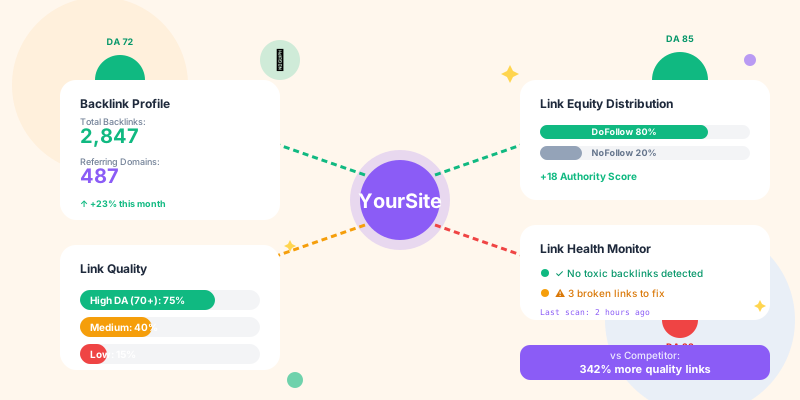
Backlinks aren't "set it and forget it." They break. They get removed. They change from dofollow to nofollow. They redirect to wrong pages. They get lost when sites redesign.
Without backlink tracking, you're building a house while the foundation crumbles behind you. You earn new links while losing old ones, never realizing you're barely breaking even.
Why Backlink Tracking Matters
The Hidden Link Equity Loss
Scenario: SaaS company link building campaign Without backlink tracking:
Month 1: Earned 50 backlinks
Month 3: Earned 100 backlinks (total: 150)
Month 6: Earned 150 backlinks (total: 300)
Month 12: Earned 200 backlinks (total: 500)

Reported: 500 backlinks earned
Reality: 327 active backlinks (173 lost or broken)
Link equity loss: 35% (you don't know about)

Outcome:
• Rankings plateau despite continued link building
• ROI of link building decreases over time
• You think you need more links (you need to fix broken ones)
Month 1: Earned 50 backlinks
Month 2: Alert: 3 backlinks now 404 → Contact sites, fix
Month 3: Earned 50 new, reclaimed 2 lost (total: 99)
Month 4: Alert: 5 backlinks removed → Investigate, request re-add
Month 6: Alert: Site redesign broke 8 links → Provide correct URLs
Month 12: Earned 200 backlinks, maintained 485 (lost only 15)

Reported: 485 active backlinks
Reality: 485 active backlinks (97% retention)
Link equity maintained

Outcome:
• Rankings continue climbing
• ROI of link building compounds
• You know exactly where you stand
Types of Backlink Problems to Monitor
1. Broken Backlinks (404 Errors)
What happened:- Linking site moved their content
- They redesigned their website
- They deleted old blog posts
- They changed their URL structure
- Link passes zero equity (404 = dead end)
- User experience is broken (bad for referral traffic)
- Google may eventually discount the backlink entirely
You have backlink from: TechBlog.com/2025/best-tools
Status: 404 Not Found
Reason: TechBlog redesigned, old URLs don't redirect
Impact: Lost link equity from high-authority site (DA 72)

Solution:
1. Contact TechBlog: "Your article about best tools is 404"
2. Provide new correct URL for your site
3. Ask them to fix the link or redirect old URL
4. Success rate: 60% (most sites will fix if you tell them)
2. Lost Backlinks (Link Removed)
What happened:- Site updated content, removed your link
- Site added nofollow to all external links
- Site removed entire section where your link was
- Site deleted the page entirely
- Zero link equity (link doesn't exist anymore)
- Lost referral traffic opportunity
- Relationship may have soured (or they just forgot about you)
You had backlink from: MarketingDaily.com/resources
Status: Page exists, but your link is gone
Reason: They updated their resource page, removed 80% of old links
Impact: Lost link from relevant, high-traffic page

Solution:
1. Check if your product/content is still relevant
2. Reach out: "I noticed you updated your resource page..."
3. Pitch why your link should be re-added (new features, updated content)
4. Success rate: 35% (harder than fixing broken links)
3. Nofollow Backlinks (Lost Link Equity)
What happened:- Site changed all external links to nofollow (policy change)
- They added sponsored/UGC attribute (rel="sponsored" or rel="ugc")
- They're being cautious about Google penalties
- Nofollow passes minimal/no link equity (still debated by SEO community)
- You thought you had a dofollow link (impacts your metrics)
- Not as critical as lost links, but reduces value
You have backlink from: NewsOutlet.com/article
Was: Your Site
Now: Your Site

Reason: NewsOutlet added blanket nofollow policy
Impact: Reduced link equity (though still valuable for traffic)

Solution:
1. Accept it (many sites adopt nofollow policies)
2. If it was sponsored/paid: rel="sponsored" is correct
3. If it's editorial/earned: Politely ask to remove nofollow (low success rate)
4. Redirect Changes
What happened:- Site added redirect chain (yoursite.com → redirect1 → redirect2 → final page)
- Site changed their redirect target
- Site broke redirect (redirect loop or error)
- Redirect chains lose ~15% link equity per hop
- Broken redirects = broken backlinks
- User experience degrades
Backlink: TechSite.com/review → yoursite.com/product
Problem: yoursite.com/product redirects to yoursite.com/products/item123
Then redirects to: yoursite.com/products/category/item123

Redirect chain: 3 hops
Link equity loss: ~30-45%

Solution:
1. Ask TechSite to update to final URL directly
2. Or fix your own redirect chain (reduce hops)
3. Use 301 redirects, not 302 (permanent vs. temporary)
How to Track Backlinks
1. Manual Monitoring (Small Scale)
For <100 backlinks: Spreadsheet tracking:
Columns:
• Referring domain
• Referring URL (exact page with your link)
• Your target URL (where link points)
• Anchor text
• Link type (dofollow/nofollow)
• Date acquired
• Last checked
• Status (active/broken/removed)
• Domain authority (from Moz, Ahrefs, etc.)

Weekly process:
1. Check each backlink manually (15 min for 50 links)
2. Verify link still exists
3. Check if still dofollow
4. Update status
5. Flag issues for outreach
- Time-consuming beyond 100 links
- Easy to miss changes
- No automatic alerts
- No historical tracking
2. Automated Backlink Monitoring Tools
For 100+ backlinks: SEO tools with backlink monitoring: Ahrefs (most comprehensive):
Features:
• Daily backlink discovery
• Lost backlink alerts (email when link disappears)
• New backlink alerts (email when you gain links)
• Broken backlink detection
• Anchor text tracking
• Competitor backlink monitoring

Cost: $99-$999/month
Best for: Professional SEO, agencies, large sites
Features:
• Backlink audit (toxic links, broken links)
• New/lost backlink reports
• Referring domain tracking
• Competitor comparison
• Link building opportunities

Cost: $119-$449/month
Best for: Full SEO suite + backlinks
Features:
• Domain authority metrics
• Spam score (identify toxic links)
• New backlink discovery
• Lost link tracking
• Link intersect (find competitor backlinks)

Cost: $99-$599/month
Best for: Small businesses, SEO beginners
Features:
• Daily backlink checks
• Email alerts for changes
• Keyword ranking tracking
• Competitor backlink monitoring

Cost: $25-$249/month
Best for: Budget-conscious, monitoring-focused
3. Short Links for Backlink Attribution
Use trackable short links in outreach: Why use short links for link building:
Instead of asking for: yoursite.com/blog/ultimate-guide-to-marketing
Ask for: yoursite.link/marketing-guide

Benefits:
• Track which outreach efforts result in clicks
• See geographic distribution of referral traffic
• Measure impact before link equity shows in Google
• Update destination URL without asking sites to change link
• A/B test landing pages (change short link destination)
Step 1: Create trackable short link
yoursite.link/guide-outreach-2026 → yoursite.com/blog/guide

Step 2: Use in outreach email
"I thought this guide might be useful for your article:
yoursite.link/guide-outreach-2026"

Step 3: Monitor performance
• How many people clicked before linking?
• Which sites sent referral traffic?
• Did traffic convert (track to sales)?

Step 4: Update if needed
Original guide URL changes? Update short link destination.
No need to contact 50 sites to update the link.
Backlink Reclamation Process
Step 1: Identify Lost/Broken Backlinks
Weekly backlink audit:
Pull report from backlink tool:
• New backlinks this week (celebrate these)
• Lost backlinks this week (investigate these)
• Broken backlinks (404 errors, redirect errors)

Prioritize by value:
High priority (fix first):
• High domain authority (DA 60+)
• Relevant industry sites
• High-traffic referrers
• Editorial links (not comments/forums)

Low priority (fix if time permits):
• Low domain authority (DA <20)
• Irrelevant sites
• Low-traffic referrers
• Low-quality links
Step 2: Investigate Why Link Was Lost
Common reasons:
1. Site redesign (most common)
   → They moved content, broke old URLs
   → Solution: Provide new correct URL

2. Content update
   → They refreshed old article, removed outdated links
   → Solution: Update your content, request re-inclusion

3. Your content is gone
   → You deleted/moved the page they linked to
   → Solution: Redirect old URL or provide new destination

4. Competitive replacement
   → They replaced your link with competitor
   → Solution: Explain why your resource is better

5. Site policy change
   → Added nofollow to all external links
   → Solution: Accept it or negotiate exception
Step 3: Outreach to Reclaim Links
Email template for broken backlinks:
Subject: Quick heads up about broken link on [Their Site]

Hi [Name],

I was reading your article "[Article Title]" and noticed one of the links appears to be broken:

[Screenshot or specific paragraph showing broken link]

I believe it was supposed to link to [your content topic]. If so, here's the updated URL:
[Your correct URL]

Happy to provide any other info if helpful.

Thanks for the great content!

[Your Name]

---

Why this works:
✓ You're helping them (broken links hurt their SEO too)
✓ No aggressive ask (just providing info)
✓ Specific (show exactly what's broken)
✓ Easy to fix (provide exact URL to use)

Success rate: 60-70% (most sites will fix)
Subject: I noticed you updated your [Resource Page]

Hi [Name],

I noticed you recently updated your [resource page / article / guide]. Looks great!

I also noticed that our [tool/guide/resource] was previously included but seems to have been removed in the update.

We've actually made significant improvements since then:
• [New feature/update 1]
• [New feature/update 2]
• [Benefit to their audience]

If it makes sense, here's the updated link:
[Your URL]

Either way, thanks for continuing to publish valuable resources!

[Your Name]

---

Why this works:
✓ No accusatory tone (just noticed)
✓ Show you've improved (not the same old link)
✓ Frame as benefit to their audience (not you)
✓ Give them easy out ("if it makes sense")

Success rate: 30-40% (harder than fixing broken links)
Step 4: Track Reclamation Success
Measure your efforts:
Backlink reclamation metrics:

• Outreach sent: 50 emails
• Response rate: 42% (21 responses)
• Fixed broken links: 17 (81% of responders)
• Re-added lost links: 6 (29% of responders)
• Total reclaimed: 23 backlinks

ROI calculation:
• Time invested: 5 hours (research + outreach)
• Links reclaimed: 23
• Average DA of reclaimed: 48
• Equivalent cost of earning 23 new DA 48 links: $2,300
• Time cost: $250 (5 hours at $50/hour)

ROI: $2,050 saved for 5 hours of work
Competitor Backlink Analysis
Reverse-Engineer Competitor Rankings
Find links you should have: Step 1: Identify link gaps
Use: Ahrefs Link Intersect or SEMrush Backlink Gap

Input:
• Your site
• Competitor 1
• Competitor 2
• Competitor 3

Result: Sites linking to 3 competitors but not you

Example output:
TechReview.com links to:
✓ Competitor A
✓ Competitor B
✓ Competitor C
✗ Your site (missing)

Action: Pitch TechReview.com for backlink
For each competitor backlink, assess:

Quality indicators:
✓ High domain authority (DA 40+)
✓ Relevant topic/industry
✓ Editorial link (in content, not sidebar/footer)
✓ Dofollow (passes link equity)
✓ Good placement (early in article, contextual)

Red flags:
✗ Low domain authority (DA <20)
✗ Irrelevant industry
✗ Paid link/sponsored (rel="sponsored")
✗ Link farm or PBN (private blog network)
✗ Foreign language (unless relevant)

Focus on high-quality backlinks only
Strategies to get same backlinks:

1. Better content
→ Competitor has guide, you create 10x better version
→ Pitch: "I noticed you linked to [competitor]. We have a more comprehensive guide..."

2. Broken link building
→ Find broken links on referring sites
→ Suggest your content as replacement

3. Resource page additions
→ Find resource pages linking to competitors
→ Pitch your content for inclusion

4. Relationship building
→ Engage with site owners on social
→ Provide value first, pitch link later

5. HARO and journalist requests
→ Respond to relevant journalist queries
→ Earn editorial mentions
Toxic Backlink Management
Identify and Disavow Harmful Links
What are toxic backlinks:
Backlinks that hurt your SEO:
• Link farms (100s of unnatural links)
• Spammy directories (low-quality, irrelevant)
• Porn/gambling sites (if not your industry)
• Hacked sites (malware, phishing)
• Over-optimized anchor text (100 exact-match "buy viagra" links)
• PBNs (private blog networks built to manipulate rankings)
Use: Moz Spam Score, Ahrefs Domain Rating, Manual Review

Red flags:
• Spam score >50 (Moz)
• Domain rating <10 with 1000s of outbound links
• Anchor text is 100% exact-match keywords
• Site language doesn't match yours (Chinese spam links)
• Site content is auto-generated nonsense
• Site has thin content (5-word pages)
Step 1: Try to remove naturally
→ Contact site owner: "Please remove link to our site"
→ Success rate: 10% (most spammers ignore requests)

Step 2: Create disavow file
Format:
# Disavow spammy links
# Date: 2026-01-17

# Individual URLs
http://spamsite1.com/page-with-link
http://spamsite2.com/another-page

# Entire domains (use sparingly)
domain:toxicdomain.com
domain:spammyfarm.info

Step 3: Submit to Google Search Console
→ Search Console > Disavow Links Tool
→ Upload disavow.txt file
→ Google will ignore those links in rankings

Warning: Use disavow carefully
Only for truly toxic links (not just low-quality)
Over-disavowing can hurt your rankings
- You received a manual penalty for unnatural links
- Links are from truly spammy sites (link farms, porn, malware)
- You have evidence the links are harming rankings (rare)
Disavowing good links by mistake can destroy your rankings. When in doubt, leave it alone.
Backlink Velocity & Natural Growth
Monitor Link Growth Patterns
What is backlink velocity:
Definition: Rate at which you acquire new backlinks over time

Healthy velocity:
• Steady growth (10-30 new links/month)
• Natural fluctuations (some months higher, some lower)
• Mix of link types (editorial, resource pages, guest posts, social)

Suspicious velocity:
• 0 links for 6 months, then 200 in one week (link buying)
• 100% exact-match anchor text (manipulative)
• All links from same IP/network (PBN)
• Sudden drop to zero (penalty or link removal)
Monthly backlink report:

Jan 2026: +23 new, -5 lost = +18 net
Dec 2025: +31 new, -8 lost = +23 net
Nov 2025: +18 new, -3 lost = +15 net

Goal: Positive net growth, steady pace

Red flag patterns:
• Huge spike (0 → 500 in a month) = Unnatural
• Sudden drop (500 → 0 in a week) = Penalty or mass removal
• Erratic (0, 200, 0, 300) = Suspicious pattern
Backlink Reporting for Stakeholders
Show Value of Link Building
Executive-friendly backlink report:
Monthly Backlink Report - January 2026

Summary:
• New backlinks acquired: 28 (+17% vs last month)
• Lost backlinks reclaimed: 12 (70% success rate)
• Total active backlinks: 487 (+35 net growth)
• Average domain authority: 52 (+3 vs last month)

Top wins:
1. Forbes mention (DA 95) → +15% traffic spike
2. TechCrunch feature (DA 93) → 2,400 referral visits
3. Industry blog (DA 68) → 340 sign-ups attributed

Impact:
• Organic traffic: +23% MoM
• Rankings improved for 47 keywords
• 12 keywords now on page 1 (was page 2)
• Estimated SEO value: $15,200/month (vs. $8,900 last month)

Visualizations:
- Line graph: Backlink growth over time
- Bar chart: New vs. lost backlinks
- Pie chart: Link types (editorial, resource, guest post)
- Heatmap: Referring domain authority distribution
Conclusion
Backlinks aren't "build and forget"—they're "build, track, maintain, and grow."Earning 500 backlinks is impressive. But if you lose 200 without noticing, you're actually at 300. Meanwhile, your competitor earned 300 and maintained 295. They're winning with fewer total backlinks earned because they kept theirs alive.
Backlink tracking reveals:
- Which links are broken (reclaim them)
- Which links were removed (win them back)
- Which links changed to nofollow (know your real profile)
- Which competitor links you should have (earn them)
- Export current backlink profile (use Ahrefs/SEMrush free trial if needed)
- Identify top 20 most valuable backlinks
- Manually verify they're still active and dofollow
- Set up automated backlink monitoring (choose a tool)
- Enable alerts for lost/broken backlinks
- Reach out to reclaim broken links (start with high DA sites)
- Run competitor backlink gap analysis
- Build relationships with sites linking to competitors
- Reclaim 50+ lost/broken backlinks
- Measure traffic and ranking impact
Stop building backlinks only to lose them silently. Start tracking them actively.
Your link profile is worth protecting.