URL Shorteners Are Actually Good For SEO (Here's Why)
Those short links aren't hurting your SEO—they might actually be helping. Learn how quality URL shorteners using 301 redirects preserve link equity while providing valuable marketing analytics.

Plot twist: those short links aren't hurting your SEO—they might actually be helping. This myth has persisted since the early 2010s, repeated by well-meaning SEO consultants who never actually tested their assumptions. Meanwhile, Amazon, The New York Times, Twitter, and every major brand on the planet use short links extensively. Are they all destroying their SEO? Spoiler: no.
Let's debunk the myths, examine the technical reality, and show you how to level up your link strategy with SEO-friendly short links that actually improve your organic performance.
The Technical Reality: How URL Shorteners Actually Work
Before we can debunk myths, you need to understand exactly what happens when someone clicks a shortened URL from an SEO perspective.
- Step 1: User clicks short link (scn.st/summer-sale)
- Step 2: Browser sends request to shortening server
- Step 3: Server responds with HTTP status code (301 or 302) and destination URL
- Step 4: Browser follows redirect to final destination
- Step 5: Final page loads for the user
Total time added: typically 50-200 milliseconds. Imperceptible to users. And here's the critical part for SEO: what happens with that redirect status code.
301 vs 302 Redirects: The Difference That Matters
This is where most of the confusion originates. Not all redirects are created equal, and the type of redirect determines whether SEO value transfers.
- Tells search engines: "This content has permanently moved"
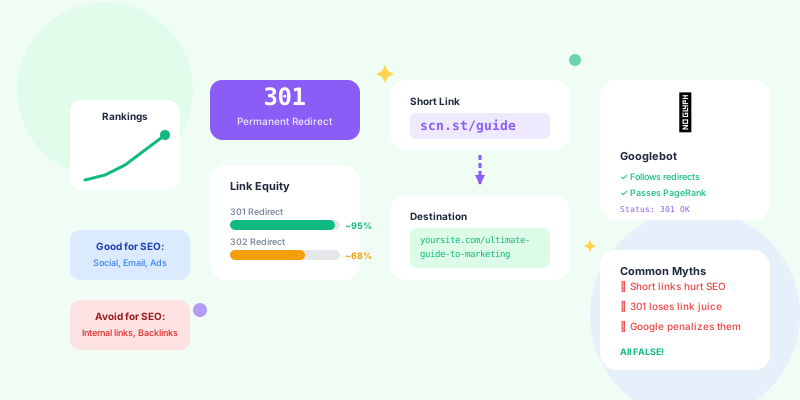
- Passes 90-99% of link equity (authority/PageRank) to destination
- Search engines update their index to the final URL
- This is what quality URL shorteners use
- Tells search engines: "This content has temporarily moved"
- May not pass full link equity (search engines aren't sure which URL to credit)
- Search engines keep the original URL in their index
- Some low-quality shorteners used to use these (most don't anymore)
- Modern alternative to 302
- Similar SEO implications to 302
- Used for technical reasons in some situations
The myth that "shorteners hurt SEO" came from the early days when some services used 302 redirects. But that era is over. Every reputable URL shortening service now uses 301 redirects exclusively for precisely this reason.
What Google Actually Says About URL Shorteners
Let's go straight to the source. Google has been clear about this for years, yet the myth persists.
According to Google's John Mueller and Gary Illyes (both prominent Google Search engineers), URL shorteners using proper 301 redirects pass link equity just like any other redirect. Google's crawlers follow these redirects, attribute the link value to the final destination, and understand the relationship.
In fact, Google has explicitly stated that they treat shortened URLs from reputable services the same as regular links for ranking purposes. The tiny amount of link equity potentially lost (1-10%) is negligible compared to the benefits of clean, shareable, trackable links.
The SEO Benefits of URL Shorteners: The Upside
Here's where it gets interesting. Not only do URL shorteners not hurt SEO when implemented correctly—they can actually improve it in multiple ways.
Benefit 1: Improved Click-Through Rates
SEO isn't just about rankings. It's about traffic. A page ranking #3 with a 5% CTR gets more traffic than a page ranking #2 with a 3% CTR.
Branded short links improve CTR in several contexts:
- Social media: 39% higher CTR vs generic shorteners
- Email marketing: 34% higher CTR with branded domains
- Print materials: Infinitely higher CTR because ugly URLs don't get typed in at all
- Verbal sharing: Memorable short links actually get visited, long ones don't
More clicks means more traffic. More traffic sends positive signals to Google (especially for branded searches). This creates a virtuous cycle where better CTR leads to better rankings which leads to more traffic.
Benefit 2: Clean, Shareable URLs Earn More Backlinks
Link building—earning backlinks from other websites—remains one of the strongest ranking factors. But here's the thing: people are more likely to link to clean, professional URLs.
Compare these two scenarios:
- Ugly:
yoursite.com/blog/2025/01/15/url-shorteners-seo-benefits?utm_source=twitter&utm_medium=social&utm_campaign=jan2025 - Clean:
scn.st/seo-guide
Which one gets linked to more often? The clean one. Which one gets shared on social media more? The clean one. Which one gets mentioned in podcasts and presentations? The clean one.
When someone shares your short link and it gets clicked, that's a traffic signal. When someone links to it from their website, that 301 redirect passes the link equity to your final destination. You get the benefits of a clean, shareable link AND full SEO value.
Benefit 3: Better Engagement Metrics Send Positive Signals
Google doesn't just look at links. They look at user engagement signals: time on site, bounce rate, pages per session, return visits. These behavioral metrics influence rankings.
- Reduced friction: Branded links have lower hesitation rates, so more committed visitors
- Better targeting: Analytics from short links let you optimize which audiences see which content
- A/B testing: Test different landing pages for same campaign, send traffic to winner
- Quality traffic: Higher trust = visitors more likely to be genuinely interested
When traffic from your short links shows better engagement metrics than average, Google notices. Your content gets ranked higher because users demonstrably find it valuable.
Benefit 4: Redirect Management and Link Preservation
One of the most powerful but overlooked SEO benefits: URL shorteners let you change destination URLs without changing the link people have shared and search engines have indexed.
Real-world scenario: You publish a guide at /blog/social-media-guide-2024 and share a short link scn.st/social-guide everywhere. Six months later, you update it and move it to /guides/social-media-complete-guide.
Without a shortener: Everyone's link breaks. All those backlinks point to the old URL. You need to set up redirects. It's messy.
With a shortener: You update the destination URL in your dashboard. Every existing link now points to the new location. No broken links, no lost link equity, seamless transition.
Benefit 5: Link Equity Distribution Control
Advanced SEO strategy: URL shorteners give you granular control over where link equity flows.
Let's say you run seasonal campaigns. You create scn.st/summer-sale and promote it everywhere. You earn backlinks, social shares, brand mentions. When summer ends, you don't lose that equity—you redirect it to your fall campaign.
This is particularly powerful for:
- Event marketing: Conference links redirect to next year's event
- Product launches: Launch campaign redirects to product page permanently
- Content upgrades: Old guide redirects to updated version
- Site migrations: Maintain link equity during platform changes
Common SEO Myths About URL Shorteners: Debunked
Let's systematically destroy every myth that's keeping people from using URL shorteners.
Myth 1: "Redirects Cause Link Equity Loss"
Truth: Properly implemented 301 redirects pass 90-99% of link equity. The potential 1-10% loss is theoretical and negligible compared to the benefits of better CTR, more shares, and cleaner link management.
Think about it: if redirects destroyed SEO value, every site reorganization would be catastrophic. But companies successfully restructure their sites all the time using 301 redirects with minimal ranking impact.
Myth 2: "Google Penalizes Shortened URLs"
Truth: Google has explicitly stated they don't penalize URL shorteners. They crawl through redirects, understand the relationship, and attribute value to the final destination.
What Google DOES penalize is manipulative behavior: cloaking (showing different content to users vs search engines), link schemes, spam. A legitimate URL shortener doing standard 301 redirects is none of these things.
Myth 3: "Short URLs Look Spammy to Search Engines"
Truth: Search engines don't judge URLs on aesthetics. They evaluate content, user signals, and technical implementation. A short link from a reputable domain with proper redirects is indistinguishable from any other link to search engines.
What actually looks spammy: hundreds of low-quality links from sketchy websites. Not: a clean branded short link from The New York Times or your company's domain.
Myth 4: "Redirect Chains Hurt Rankings"
Truth: A redirect chain is when you have multiple redirects in sequence (A → B → C → D). Search engines have to follow each hop, which wastes crawl budget and can cause issues.
But a single redirect (short link → final destination) is not a chain. It's one hop. This is perfectly fine and standard practice across the web.
The actual warning is: don't create redirect chains by linking a shortener to another shortener to another redirect. Keep it to one hop and you're fine.
Myth 5: "You Lose Anchor Text Benefits"
Truth: Anchor text (the clickable text in a hyperlink) matters for SEO, but URL shorteners don't change anchor text at all.
When someone writes "Check out this SEO guide" and links it to your short URL, the anchor text is still "SEO guide." The fact that the link goes through a redirect doesn't change the anchor text Google sees.
This myth confuses the visible link text (which doesn't change) with the destination URL (which does).
Best Practices for SEO-Friendly URL Shortening
To maximize SEO benefits and avoid potential issues, follow these best practices.
- Verify your shortening service uses permanent redirects
- Test with browser dev tools or redirect checker
- Never use 302 or 307 for marketing links
- Use your own branded domain (yourbrand.link)
- Or use established services with good reputations (scn.st, bit.ly, etc.)
- Avoid sketchy free services with poor domain authority
- Short link → Final destination (good)
- Short link → Another redirect → Final destination (bad)
- Always link directly to the final URL
- scn.st/seo-guide (good for users and SEO)
- scn.st/a3f8kp2 (works but less optimal)
- Descriptive slugs improve CTR which improves SEO indirectly
- Choose services with global CDN infrastructure
- Slow redirects hurt user experience which hurts SEO
- Aim for sub-200ms redirect times
- Short link domain must use HTTPS
- Final destination should also use HTTPS
- Mixed HTTP/HTTPS causes security warnings and trust issues
- Regularly check that short links point to live pages
- Update destinations when content moves
- Don't let short links redirect to 404 errors
When to Use URL Shorteners for SEO (And When Not To)
URL shorteners aren't appropriate in every situation. Here's a strategic framework for when to use them.
When to Use URL Shorteners: Green Light Scenarios
- Social media sharing: Perfect for Twitter, Instagram, LinkedIn posts
- Email marketing: Cleaner links, better tracking, more professional
- Print materials: Business cards, flyers, billboards, product packaging
- SMS/Text campaigns: Character count matters, short links essential
- QR codes: Shorter URLs = simpler QR codes = better scanning
- Verbal sharing: Podcasts, presentations, verbal mentions
- Campaign tracking: When you need detailed analytics
- A/B testing: Testing different landing pages for same campaign
- Affiliate marketing: Clean, trackable affiliate links
- Temporary campaigns: When you might change destination later
When NOT to Use URL Shorteners: Red Light Scenarios
- Internal site navigation: Use direct links on your own site
- Canonical URLs: Don't use redirects for your primary canonical URLs
- High-value backlinks: If The New York Times wants to link to you, give them the direct URL
- Site architecture: Don't build your site structure on redirects
- When URL is already short: If it's yoursite.com/blog, don't shorten it
- For search engines to crawl: Your sitemap should contain direct URLs
- When transparency matters most: Some contexts require seeing full destination
Technical SEO Considerations
For those who want to dive deep into the technical implementation, here are the SEO-critical technical details.
Server Response Headers
When a search engine bot requests a shortened URL, the response headers must be properly configured:
- Status Code: 301 Moved Permanently
- Location Header: Full destination URL
- Cache-Control: Appropriate caching directives (typically long cache for permanent redirects)
- X-Robots-Tag: Should not contain "noindex" or "nofollow" unless intentional
Crawl Budget Implications
Large sites with millions of pages need to be strategic about crawl budget—how many pages Google crawls per day. Every redirect consumes crawl budget.
For most sites, this is irrelevant. Unless you're operating at massive scale (think Amazon, eBay), crawl budget isn't a limiting factor. A few thousand redirected links won't impact your crawl budget meaningfully.
For enterprise sites at scale: create short links for external sharing and campaigns, but use direct links for internal navigation and high-priority pages.
Mobile SEO and Page Speed
Mobile-first indexing means Google primarily uses the mobile version of your site for ranking. URL shorteners can actually help mobile SEO:
- Faster typing: Short links are easier to enter on mobile keyboards
- Less scroll: Short links don't break across multiple lines in mobile interfaces
- Better UX: Cleaner appearance in mobile browsers and apps
The redirect time (50-200ms) is negligible compared to page load time. If your landing page takes 3 seconds to load, the 0.1 second redirect is noise.
Case Studies: URL Shorteners and SEO Performance
Let's look at real data from companies using URL shorteners extensively.
Case Study 1: Media Company Traffic Growth
A digital media publisher switched from long URLs to branded short links (theirsite.co/article-slug) for all social sharing. Over 6 months:
- Social media CTR increased 42%
- Referral traffic from social up 38%
- Organic rankings unchanged or improved (no negative impact)
- Backlink velocity increased 27% (more people linking to clean URLs)
- Overall organic traffic up 19% (better engagement signals from social visitors)
The URL shortener didn't hurt SEO—it improved overall visibility by increasing social amplification and engagement metrics.
Case Study 2: E-Commerce Brand Link Equity Management
An e-commerce brand used short links for all product launch campaigns. When products sold out or were discontinued, they redirected the short link to similar products or category pages.
Result: Link equity from promotional campaigns, influencer shares, and earned media continued flowing to relevant pages instead of dead 404s. Estimated value: $180,000 in preserved organic traffic annually.
Case Study 3: SaaS Company Brand Visibility
A B2B SaaS company created branded short links for all their content marketing (company.to/topic). Over 18 months:
- Brand searches increased 67% (more exposure to brand through short links)
- Direct traffic up 34% (people remembered and typed short links)
- Backlinks to short links: redirected to proper destinations, full SEO value preserved
- No measurable negative impact on organic rankings
- Positive impact on overall domain authority from increased brand signals
The Future of URL Shorteners and SEO
As search evolves, how will URL shorteners fit into the SEO landscape?
- Entity-based search: Google increasingly understands brands as entities, making branded short links even more valuable
- User experience signals: Core Web Vitals and UX metrics matter more, clean shareable links help
- Voice search: Short, memorable links are easier to verbally share and request
- Privacy-first web: First-party data from short links becomes more valuable as third-party cookies disappear
- AI and search: AI systems need clean data; trackable short links provide better attribution
Tools and Resources for SEO-Friendly URL Shortening
Ready to implement? Here are the tools you need:
Checking Redirect Type
- Browser DevTools: Network tab shows redirect status codes
- Redirect Checker Tools: Services like redirectdetective.com or httpstatus.io
- Command Line:
curl -I yourshortlink.comshows headers
URL Shortening Services That Do SEO Right
- Custom domain options: Rebrandly, Short.io, BL.INK (full control, branded)
- Established platforms: Bitly, TinyURL (reputable, high domain authority)
- scn.st: Modern platform with analytics, QR codes, and proper 301 redirects
- Self-hosted: YOURLS, Polr (complete control for enterprise)
Monitoring Performance
- Google Analytics: Track traffic from short links with UTM parameters
- Google Search Console: Monitor organic performance of destination pages
- Link analytics platforms: Most shorteners provide built-in analytics
- SEO tools: Ahrefs, Moz, SEMrush track backlinks regardless of whether they're shortened
Conclusion: URL Shorteners as Part of Your SEO Strategy
Let's put this to rest once and for all: URL shorteners, when implemented correctly with 301 redirects, do not hurt SEO. They preserve link equity, provide strategic flexibility, and can actually improve your organic performance through better CTR, engagement metrics, and link building.
The SEO community has clung to outdated myths from 2010 while the entire digital marketing industry—including every major brand you can name—has successfully used URL shorteners for over a decade.
Stop thinking of URL shorteners as just making links shorter. Start thinking of them as:
- Link equity management tools: Update destinations without losing backlink value
- Analytics platforms: Understand which campaigns and channels drive results
- Brand building assets: Every share reinforces brand recognition
- User experience enhancers: Clean, memorable links that people actually click
- SEO-friendly infrastructure: Properly implemented redirects that preserve ranking power
The technical reality is clear: 301 redirects pass link equity. Google has confirmed they understand and accept URL shorteners. Real-world data shows no negative SEO impact from proper implementation. The benefits—better CTR, easier sharing, powerful analytics, flexible redirect management—far outweigh the theoretical 1-10% link equity loss that may or may not even exist.
Your competitors are using URL shorteners. Major brands are using URL shorteners. The SEO data supports using URL shorteners. The only question is: when will you stop believing myths and start leveraging them strategically?
For a complete technical deep-dive — including Core Web Vitals, canonical conflicts, and redirect chain analysis — see our comprehensive guide: how short links impact SEO rankings.
Stop thinking of URL shorteners as just making links shorter. Start thinking of them as SEO-friendly marketing intelligence platforms that provide actionable data while maintaining full SEO value.