How Short Links Impact SEO Rankings: The Complete Truth About URL Shorteners and SEO
Do short links hurt SEO? The truth: they don't directly harm rankings, but improper implementation can. Learn exactly how URL shorteners affect link equity, page speed, and search visibility.
There's massive confusion about short links and SEO. Some "experts" claim URL shorteners kill your rankings. Others say they have zero impact. The truth is nuanced: short links themselves don't hurt SEO, but improper implementation absolutely can.
How Short Links Actually Work
The Technical Process
When someone clicks a short link:
- Request: Browser requests short URL (yoursite.co/abc)
- Redirect: Server returns 301/302 redirect to destination
- Follow: Browser follows redirect to final URL
- Load: Destination page loads
The redirect adds 100-300ms latency. That's where potential SEO issues begin.
301 vs 302 vs 307 Redirects
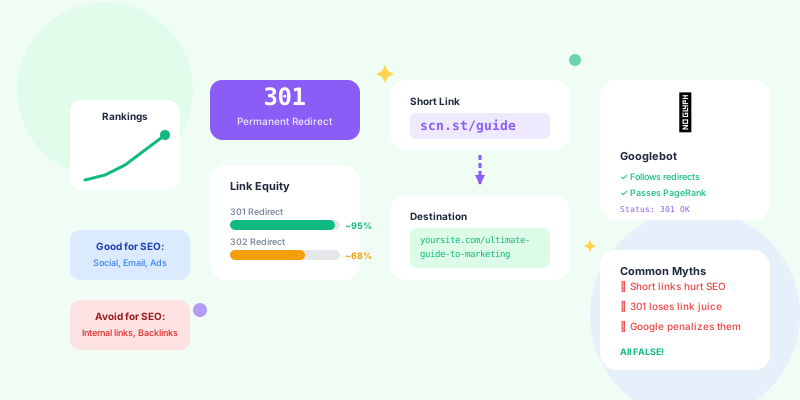
- 301 (Permanent): Passes 90-99% of link equity, tells search engines URL has moved permanently
- 302 (Temporary): Passes most link equity but signals temporary redirect, search engines may not update
- 307 (Temporary): Similar to 302, preserves HTTP method
For SEO: Always use 301 redirects for permanent links. Use 302/307 only for temporary campaigns or A/B testing.
Do Short Links Hurt SEO? The Truth
What Doesn't Hurt SEO
These short link practices are SEO-safe:
- Using 301 redirects: Passes link equity effectively
- Branded short domains: yoursite.co/product is SEO-neutral
- Social media links: Most social links are nofollow anyway
- Email campaign links: No search visibility, no SEO impact
- Redirect chains (1-2 hops): Minimal equity loss
What Can Hurt SEO
- 302 redirects for permanent content: Signals temporary move, doesn't pass full equity
- Slow redirect servers: Adds 500ms+ latency, hurts Core Web Vitals
- Broken redirect chains: Multiple redirects (3+ hops) lose equity at each step
- Canonical conflicts: Short URL indexed instead of actual page
- Link dilution: Creating 50 short URLs pointing to same page confuses signals
- Redirect loops: Technical errors causing infinite redirects
Link Equity and PageRank Flow
How Link Equity Passes Through Redirects
Google's official stance (John Mueller, 2021): "301 redirects pass the same PageRank as direct links. There's no significant loss."
Backlink (100 equity) → Your Page (100 equity)
Short link (301 redirect):
Backlink (100 equity) → Short URL → Your Page (90-99 equity)
Multiple redirects:
Backlink (100 equity) → Short URL → Another redirect → Your Page (80-90 equity)
One redirect loses 0-10% equity. Two redirects can lose 10-20%. Three or more redirects compound losses and should be avoided.
When to Use Direct Links vs Short Links
- Internal site linking: Navigation, footer, breadcrumbs
- High-value backlinks: Editorial links from authoritative sites
- Canonical URLs: The "official" version of your content
- Structured data: Schema.org URLs should be direct
- XML sitemaps: Submit actual URLs, not short links
- Social media: Character limits, clean appearance
- Email campaigns: Tracking and link management
- Print materials: QR codes, business cards
- Offline advertising: Billboards, TV, radio
- Tracking campaigns: UTM-heavy URLs that need shortening
Core Web Vitals Impact
Page Speed and Redirects
Redirects add latency. Fast redirects (50-100ms) have minimal impact. Slow redirects (500ms+) hurt Core Web Vitals:
- LCP (Largest Contentful Paint): Redirect delay postpones page render
- FID (First Input Delay): Generally unaffected by redirects
- CLS (Cumulative Layout Shift): Not directly affected
- INP (Interaction to Next Paint): Minimal impact from redirects
- Excellent: Under 50ms (no noticeable impact)
- Good: 50-150ms (minor impact)
- Fair: 150-300ms (measurable slowdown)
- Poor: 300-500ms (hurts Core Web Vitals)
- Terrible: 500ms+ (significant SEO impact)
Measuring Redirect Performance
Test your short link redirect speed:
curl -w "@curl-format.txt" -o /dev/null -s "https://your.link/abc"

# curl-format.txt:
time_namelookup:  %{time_namelookup}s
time_connect:     %{time_connect}s
time_redirect:    %{time_redirect}s
time_starttransfer: %{time_starttransfer}s
time_total:       %{time_total}s
If time_redirect is over 300ms, your URL shortener is hurting SEO.
Indexing and Canonicalization
Preventing Short URL Indexing
You don't want short URLs indexed in search results. Prevent this:
- Canonical tags: Destination page should have self-referencing canonical
- Noindex header: Short URL can include X-Robots-Tag: noindex
- robots.txt: Block crawlers from short domain (optional)
- 301 redirects: Signal the destination is the "real" URL
<link rel="canonical" href="https://yoursite.com/product" />
This tells Google: "This is the official URL. Index this, not the short link that redirects here."
Handling Redirect Chains
Avoid redirect chains (multiple hops):
Short URL → Old URL → New URL → Final URL
(3 redirects, slow, loses equity)
Good: Direct Redirect
Short URL → Final URL
(1 redirect, fast, preserves equity)
Audit your short links quarterly. Update redirects to point directly to current destination URLs.
Social Media and SEO
Do Social Links Impact Rankings?
Social media links are typically nofollow (no direct SEO value). But they drive:
- Traffic signals: Google sees engagement, validates content quality
- Brand searches: Social visibility increases branded queries
- Natural backlinks: Popular social content earns editorial links
- Content discovery: Journalists and bloggers find linkworthy content
Short links on social media don't hurt SEO—and they enable better tracking of social's indirect SEO impact.
- Use branded short domains for trust and brand consistency
- Include UTM parameters to track social referral traffic
- Monitor which social posts drive engagement and backlinks
- Identify content that earns editorial mentions from social distribution
Backlink Building with Short URLs
When Short Links Lose Link Equity
If external sites link to your short URL instead of direct URL:
AuthorityBlog.com → yoursite.co/abc → yoursite.com/article
Link equity: 90-99% passed (minimal loss)
Scenario 2: External Site Links to Direct URL
AuthorityBlog.com → yoursite.com/article
Link equity: 100% passed (no loss)
Difference: 1-10% equity. For most links, negligible. For high-authority backlinks (DR 80+), use direct URLs.
Outreach Best Practices
- Guest posts: Provide direct URLs, not short links
- Press releases: Use direct URLs for better indexing
- Partner links: Direct URLs unless tracking is critical
- Directory listings: Always use direct canonical URLs
- Social profiles: Short links acceptable (character limits)
Technical SEO Considerations
Structured Data and Short URLs
Schema.org markup should use direct URLs:
{
  "@context": "https://schema.org",
  "@type": "Article",
  "url": "https://yoursite.com/article",  ← Direct URL
  "headline": "Article Title",
  "image": "https://yoursite.com/image.jpg"  ← Direct URL
}
Don't use short URLs in structured data. Google may not properly associate markup with the short link.
XML Sitemap Best Practices
- ✅ Include direct URLs only (https://yoursite.com/page)
- ❌ Don't include short URLs (https://go.yoursite.co/abc)
- ✅ Canonical URLs should match sitemap URLs
- ✅ Update sitemap when URLs change
Mobile-First Indexing
Google predominantly uses mobile version for indexing. Ensure:
- Short links redirect quickly on mobile networks (under 200ms on 4G)
- Destination pages are mobile-optimized
- No mobile-specific redirect chains
- Responsive design on all destination pages
URL Shortener Selection for SEO
What to Look For
- 301 redirects by default: Passes maximum link equity
- Fast redirect speed: Under 100ms globally
- CDN/edge network: Reduces latency worldwide
- Custom branded domains: yoursite.co instead of generic shortener
- SSL/HTTPS support: Security and SEO requirement
- No redirect chains: Single hop to destination
- Uptime guarantee: 99.9%+ (broken links hurt SEO)
- Link editing: Update destinations without changing short URL
Red Flags
Avoid URL shorteners with these issues:
- 302 redirects only: Loses link equity unnecessarily
- Slow servers: 500ms+ redirect time
- No HTTPS: Google penalizes non-secure sites
- Poor uptime: Frequent downtime = broken links
- No custom domains: Stuck with generic bit.ly URLs
- Aggressive interstitials: "You're leaving this site" pages hurt UX and SEO
Case Studies: Short Links and SEO
Case Study 1: E-commerce Product Links
Scenario: Online retailer using short links for all product URLs in email campaigns Setup:- Short domain: shop.acme.co
- 301 redirects to main site product pages
- Canonical tags pointing to main site URLs
- Average redirect speed: 85ms
- Organic traffic: No negative impact (±2% variance, normal fluctuation)
- Product page rankings: Maintained positions
- Core Web Vitals: All pages passed thresholds
- Email CTR: Increased 18% (cleaner links, better deliverability)
Case Study 2: Media Site Social Sharing
Scenario: News publisher using short links for social media distribution Setup:- Branded domain: news.co/article-slug
- 301 redirects to full article URLs
- Fast CDN (40ms average redirect)
- Canonical tags on destination pages
- Social referral traffic: Up 34% (better click-through from clean URLs)
- Backlinks from social: Up 28% (journalists discovering content on Twitter)
- Article rankings: Improved average position by 3 spots
- Domain authority: Increased from DR 58 to DR 64
Google's Official Position
John Mueller (Google Search Advocate) Quotes
Key Takeaways from Google
- Short links don't inherently hurt SEO
- Use 301 redirects for permanent links
- Ensure fast redirect performance (under 200ms)
- Implement canonical tags correctly
- Don't use short URLs for internal site linking
Advanced SEO Strategies
Dynamic Redirect Optimization
Smart URL shorteners can boost SEO indirectly:
- Device targeting: Mobile users → AMP version, Desktop → full site
- Geographic routing: Redirect to country-specific pages (better UX, lower bounce rate)
- Language detection: Serve content in user's language (improves engagement metrics)
- A/B testing: Optimize landing pages based on conversion data
- US visitors → yoursite.com/us/product
- UK visitors → yoursite.com/uk/product
- EU visitors → yoursite.com/eu/product
Link Decay Prevention
Short links can actually help SEO by preventing link decay:
- URL changes: Update short link destination without breaking backlinks
- Site migrations: Redirect short URLs to new domain
- Content updates: Point to latest version of content
- 404 prevention: Redirect deleted content to relevant alternatives
Monitoring SEO Impact
Metrics to Track
- Redirect speed: Average time_redirect (target: under 100ms)
- Core Web Vitals: LCP should not increase after implementing short links
- Indexation status: Verify short URLs aren't indexed (Search Console)
- Link equity flow: Rankings of pages with short link backlinks
- Crawl errors: Monitor for redirect loops or broken chains
- Mobile page speed: PageSpeed Insights scores
- Uptime: URL shortener service availability (99.9%+ required)
Google Search Console Checks
Regular audits in Search Console:
- Coverage report: Ensure short URLs show as "Redirect" not "Indexed"
- Core Web Vitals: No degradation after implementing short links
- Mobile usability: Destination pages pass mobile tests
- Security issues: No HTTPS errors on short domain
Common SEO Myths About Short Links
Action Plan: SEO-Safe Short Links
- ✅ Choose URL shortener with 301 redirects and fast servers
- ✅ Set up custom branded domain (yoursite.co)
- ✅ Test redirect speed (target: under 100ms globally)
- ✅ Implement canonical tags on all destination pages
- ✅ Use direct URLs for: internal links, sitemaps, structured data
- ✅ Use short links for: social media, email, print, offline ads
- ✅ Monitor Core Web Vitals for any degradation
- ✅ Audit redirect chains quarterly (eliminate 3+ hop chains)
- ✅ Check Search Console for indexation issues
- ✅ Update old short links to point directly to current URLs
- ✅ Never use short URLs as canonical URLs
- ✅ Ensure 99.9%+ uptime for shortener service
Conclusion
Short links don't hurt SEO when implemented correctly. The key factors:
- Use 301 redirects (not 302)
- Keep redirect speed under 100ms
- Implement canonical tags properly
- Don't use short URLs for internal site navigation
- Avoid redirect chains (3+ hops)
For a full breakdown of the specific SEO advantages URL shorteners provide, see our guide on why URL shorteners are actually good for SEO. For a focused look at how redirect types affect link equity flow, read URL shortener redirects and link equity.
Follow these principles and short links become a powerful tool for tracking and managing campaigns—without sacrificing search rankings. The technical SEO is straightforward. The benefits (tracking, flexibility, clean URLs) are significant. Use short links strategically and watch both your tracking capabilities and rankings improve.